Full-Service Removal
Pool removal, start to finish.
An unused pool is a standing maintenance bill and a chunk of yard you cannot use. We take the whole job — demolition, hauling, backfill and final grade — and hand back ground you can actually do something with.
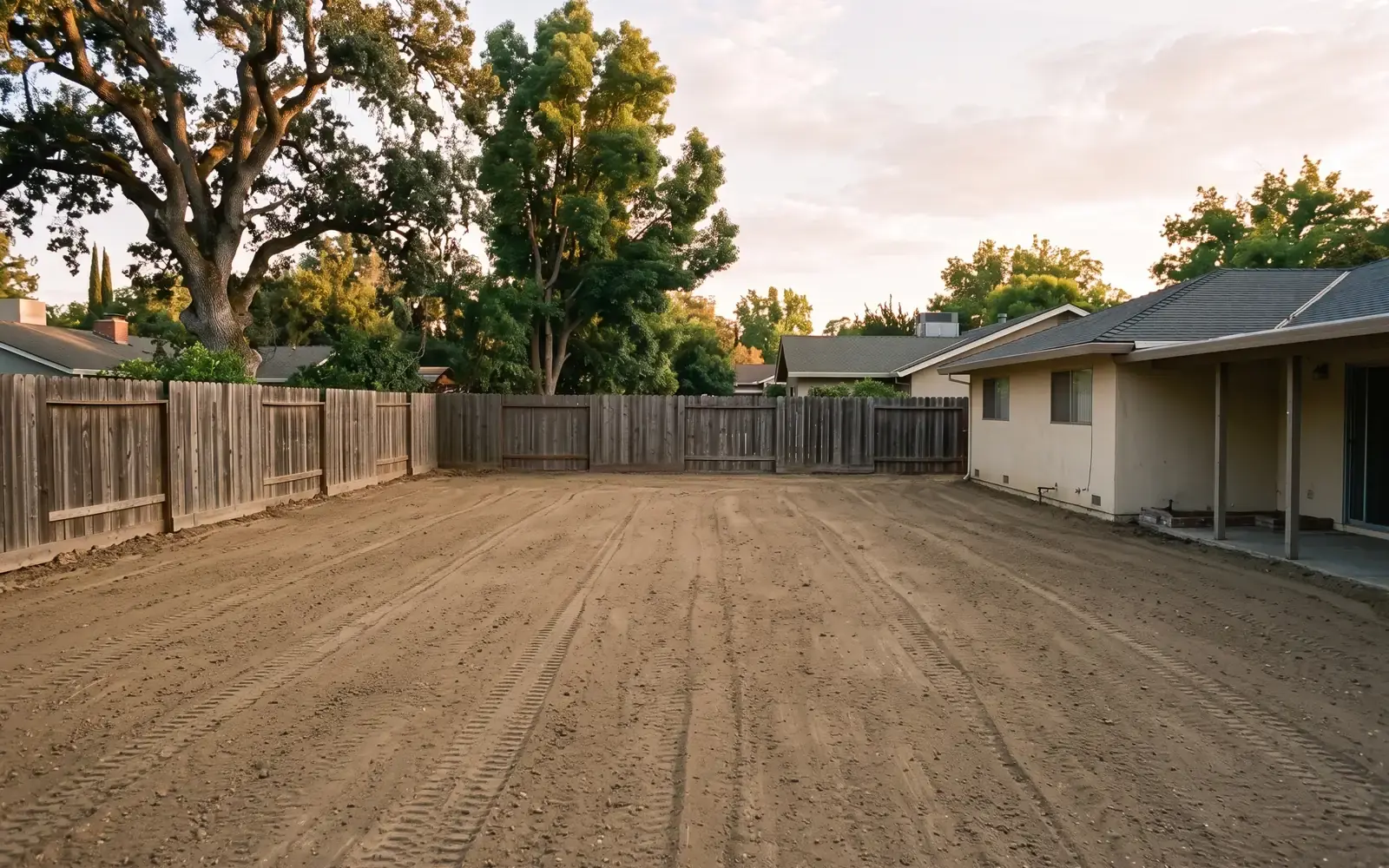
Plate 01—Final Grade
Full & Partial Removal
Permit Coordination
Debris Hauled Away
Backfill & Final Grade
The Work
What is involved in removing a pool?
Pool removal is a demolition project with a drainage problem attached. The shell has to come out to the approved scope, the material has to leave the property, and the void has to be filled in a way that will not settle in three years. Most of the trouble people run into afterwards — sinking, soft spots, water pooling against the house — traces back to fill that was pushed in rather than placed and compacted in lifts.
The other half of the job is paperwork and access. Removal is generally a permitted demolition, and every jurisdiction handles it slightly differently. Getting equipment into a fenced backyard without taking out a wall, a line or a neighbour’s driveway is its own planning problem, and it is one of the first things we look at on the site walk.
Two ways to do it
Partial fill-in
Remove the upper portion of the pool shell, create required drainage openings, place approved fill and compact it in lifts, then rough grade the area. This option is generally intended for open-yard uses when no future structure is planned, subject to local requirements.
Guys’ NoteLearn more about partial fill-inAccess affects equipment choice.
Full removal
Remove and haul away the entire pool shell, then backfill and compact the excavation before final grading. This is generally preferred when future construction may use the former pool footprint.
Guys’ NoteLearn more about full removalFuture builds usually require full removal.
Requirements vary by jurisdiction and property. Your local building department determines which option is permitted and what documentation it needs. We coordinate the paperwork and tell you what we learn.
Compare both options side by sideHow the project runs
Five stages. One written plan.
- 1
Plan
Walk the site, confirm the removal goal, access and visible constraints.
- 2
Permit
Prepare and coordinate paperwork with the department serving the property.
- 3
Remove
Demolish the shell to the approved scope and haul debris away.
- 4
Backfill & Compact
Place approved fill in lifts according to the project requirements.
- 5
Grade & Document
Finish the surface to the agreed grade and close out available project records.
Next step
Ready to find out what your property needs?
A site walk is where an accurate scope starts — access, shell type, depth, utilities and what you want the ground to do afterwards.
Decision Point
When removal makes more sense than repair.
The repair bill keeps growing
Replaster, new equipment, a leak nobody can find. At some point the pool costs more to keep than to remove.
Nobody swims in it
A pool that gets used twice a summer is still being heated, chemically treated and cleaned all year.
You want the yard back
A pool footprint is often the largest single piece of a Sacramento backyard. Removing it changes what the property can do.
You are planning to build
An addition, an ADU or a shop over the old footprint generally points to full removal rather than partial fill-in.
Safety and insurance
An unused pool is still an attractive nuisance, and carriers treat it as one.
You are selling
Buyer reaction to a neglected pool is rarely neutral. Talk to your agent before deciding either way.
By Pool Type
What the shell is made of changes the work.
Not marginally. A reinforced gunite shell and a one-piece fiberglass shell are different demolitions with different equipment and different disposal streams, and an above-ground pool is barely a demolition at all.
Concrete & gunite
The most common in-ground shell in this region, and the heaviest to break out.
Fiberglass
A one-piece shell that comes out differently — and often more cleanly — than concrete.
Vinyl-liner
Liner, then the wall panels and footing underneath them. Two materials, two disposal streams.
Above-ground
A different job entirely: no shell to demolish, but a base and a footprint left behind.
Start With The Site
Tell us about the pool.
An accurate scope starts with the property: access, shell type, depth, utilities and what you want the ground to do afterwards. Send the basics and we will set up a site walk.
Send the basics
Four required answers. Add detail only if it helps.
Walk the property
We confirm access and the scope on site.
Get it in writing
Recommended option, sequence and what happens next.
No obligation, no pressure
Request a site estimate.
Start with the property and what you want the ground to do afterwards. We will follow up to arrange the site walk and confirm the scope.
Plan The Project
The decisions that come next.
What it costs
Access, material, depth, hauling, fill and permits — the drivers behind any number.
Who issues your permit
All 27 communities we serve, and the department that handles each one.
Backfill and compaction
Why the fill step decides how the ground behaves years later.
Where we work
Four counties, grouped by the thing that actually matters: jurisdiction.
Removing a pool to build
If a structure is going on that footprint, the scope changes.
Removing before selling
Disclosure, documentation and timing against a listing.
Questions people ask first
Permits, timelines, what stays in the ground and what does not.
The project guides
Longer reads on timing, contractor questions and what to do with the space.