Option 1 Of 2
Partial pool removal.
Remove the upper portion of the pool shell, create required drainage openings, place approved fill and compact it in lifts, then rough grade the area. This option is generally intended for open-yard uses when no future structure is planned, subject to local requirements.
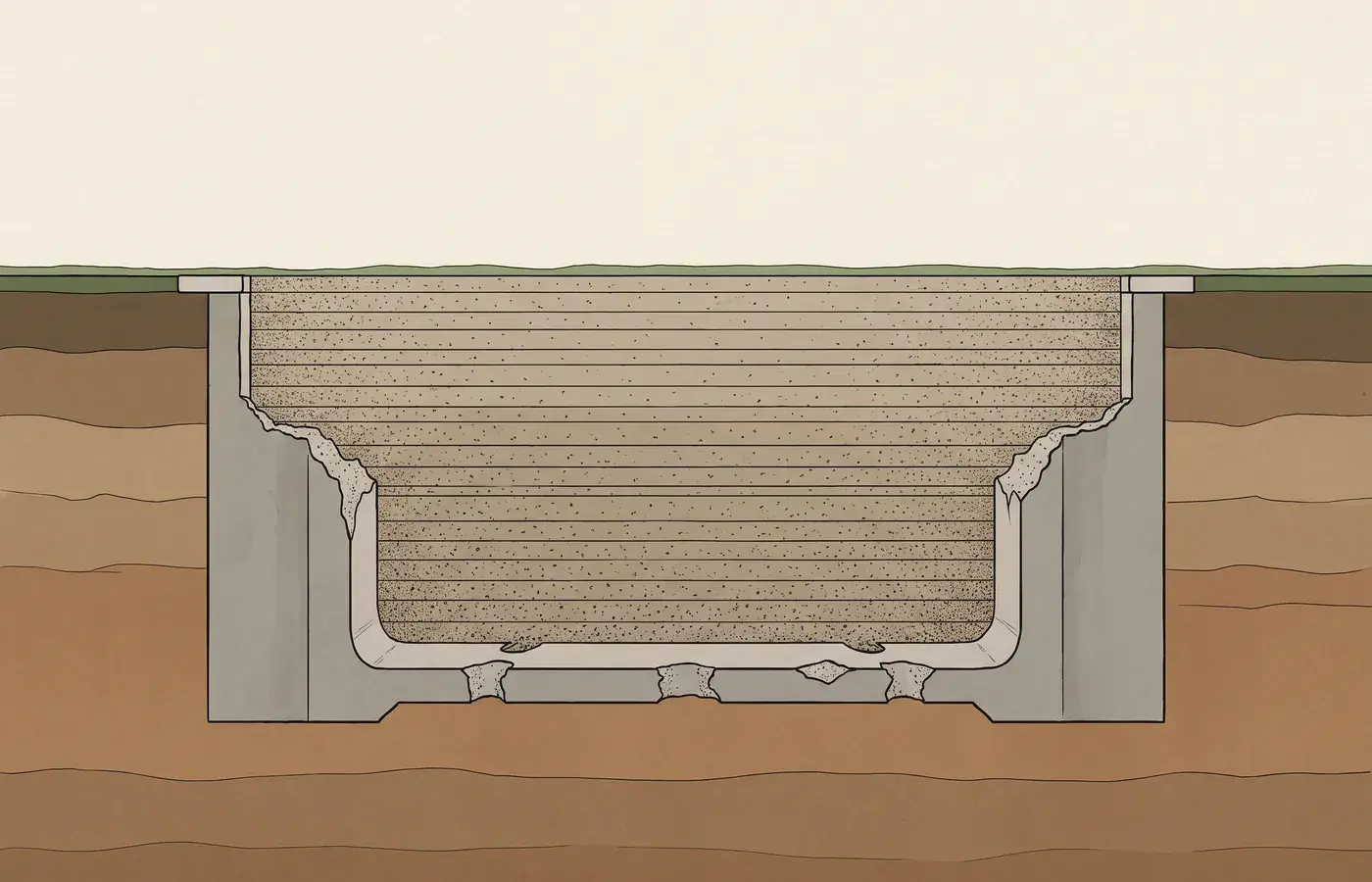
Plate 01—Partial fill-in
The Process
How does partial pool removal work?
Access affects equipment choice.
- 1
Upper shell comes out
The top portion of the shell — typically the visible walls and the bond beam — is broken out and hauled off.
- 2
Drainage openings are cut
Openings are made through the remaining base so water can pass through rather than collecting in a concrete bowl underground. This step is what separates a proper fill-in from simply dumping dirt in a pool.
- 3
Approved fill goes in, in lifts
Fill is placed in layers and compacted as it goes. Depth per lift and the compaction method depend on the material and on local requirements.
- 4
The area is rough graded
The surface is brought to grade and shaped to drain away from structures.
Fit Check
Where it fits — and where it does not.
Generally a good fit for
- Open-yard uses: lawn, planting, play space.
- Properties where equipment access is tight or expensive.
- Owners who want the pool gone without the fuller scope.
Think carefully if
- You may build a structure over the footprint. That generally points to full removal.
- You expect the area to carry heavy loads later.
- You are planning to sell soon — disclosure obligations apply to a filled-in pool, and buyers ask.
Requirements vary by jurisdiction and property. Your local building department determines which option is permitted and what documentation it needs. We coordinate the paperwork and tell you what we learn.
Compare partial and full removal side by sideNext step
Ready to find out what your property needs?
A site walk is where an accurate scope starts — access, shell type, depth, utilities and what you want the ground to do afterwards.
Scope Boundaries
What a proper fill-in has to account for.
Partial removal is not shorthand for putting soil in an empty pool. The remaining shell, drainage path, imported material, compaction and final grade all stay part of the job. The written scope should also say where the work stops so decking, landscaping and utilities are not left to assumption.
The buried condition
The lower shell remains, which is why the permit record and final documentation matter. The property has changed even when the finished yard looks ordinary, and future owners or designers should not have to guess what sits below it.
Drainage through and over the fill
Openings through the remaining base address subsurface water. The graded surface addresses rain and irrigation above it. Both paths matter; solving one while leaving a low spot over the footprint is incomplete work.
Lift placement and access
Approved fill is placed in manageable layers and compacted as the excavation rises. Narrow access can change the equipment, delivery sequence and labour needed to move material without treating neighbouring paving or fences as expendable.
What comes after grade
The removal scope normally ends at rough or final grade as stated in the proposal. Lawn, planting, irrigation, patios and play surfaces are follow-on decisions, and heavy or structural uses need separate review before the removal method is selected.
Where You Are
Partial removal in your area.
The method is the same everywhere. What changes is which building department reviews it, what that department publishes, and what else applies on your lot — tree ordinances, right-of-way staging, septic setbacks, debris diversion. Each of these pages covers the local layer.
- Sacramento fill-in
- Roseville fill-in
- Rocklin fill-in
- Folsom fill-in
- Elk Grove fill-in
- Citrus Heights fill-in
- Carmichael fill-in(Sacramento County)
- Fair Oaks fill-in(Sacramento County)
- Rancho Cordova fill-in
- Orangevale fill-in(Sacramento County)
- Lincoln fill-in
- Granite Bay fill-in(Placer County)
- El Dorado Hills fill-in(El Dorado County)
Partial removal questions.
The lower portion of the pool shell remains in place after the approved upper section is removed. Drainage openings are made through the remaining base, then approved fill is placed and compacted above it. The exact amount removed and the opening requirements come from the permit scope for that property.
Start With The Site
Considering a partial fill-in?
Tell us how you want to use the finished yard. That goal, the access and the local permit scope determine whether partial removal is a responsible fit.
Send the basics
Four required answers. Add detail only if it helps.
Walk the property
We confirm access and the scope on site.
Get it in writing
Recommended option, sequence and what happens next.
Still researching the work? Read the complete pool removal service overview.
No obligation, no pressure
Request a site estimate.
Start with the property and what you want the ground to do afterwards. We will follow up to arrange the site walk and confirm the scope.
Read Next
Related reading.
Full pool removal
The alternative, and the one to read if a structure may go on that footprint.
Backfill and compaction
Drainage openings and lift compaction are what separate a fill-in from dumped dirt.
What it costs
Less material moves on a fill-in, which is exactly why access matters less here.
Who issues your permit
Two jurisdictions we serve publish pool-specific fill requirements. Most do not.
Removing before you sell
Buried concrete is a known condition. Worth understanding before you list.
What to do afterwards
What the ground over a fill-in can and cannot take.