Shell Material
Concrete and gunite pool removal.
Gunite, shotcrete and poured concrete pools all cure into the same reinforced shell, and they all demolish the same way. This is the heaviest material we remove in the Sacramento region, and the one where partial versus full removal changes the most about what stays in your yard.
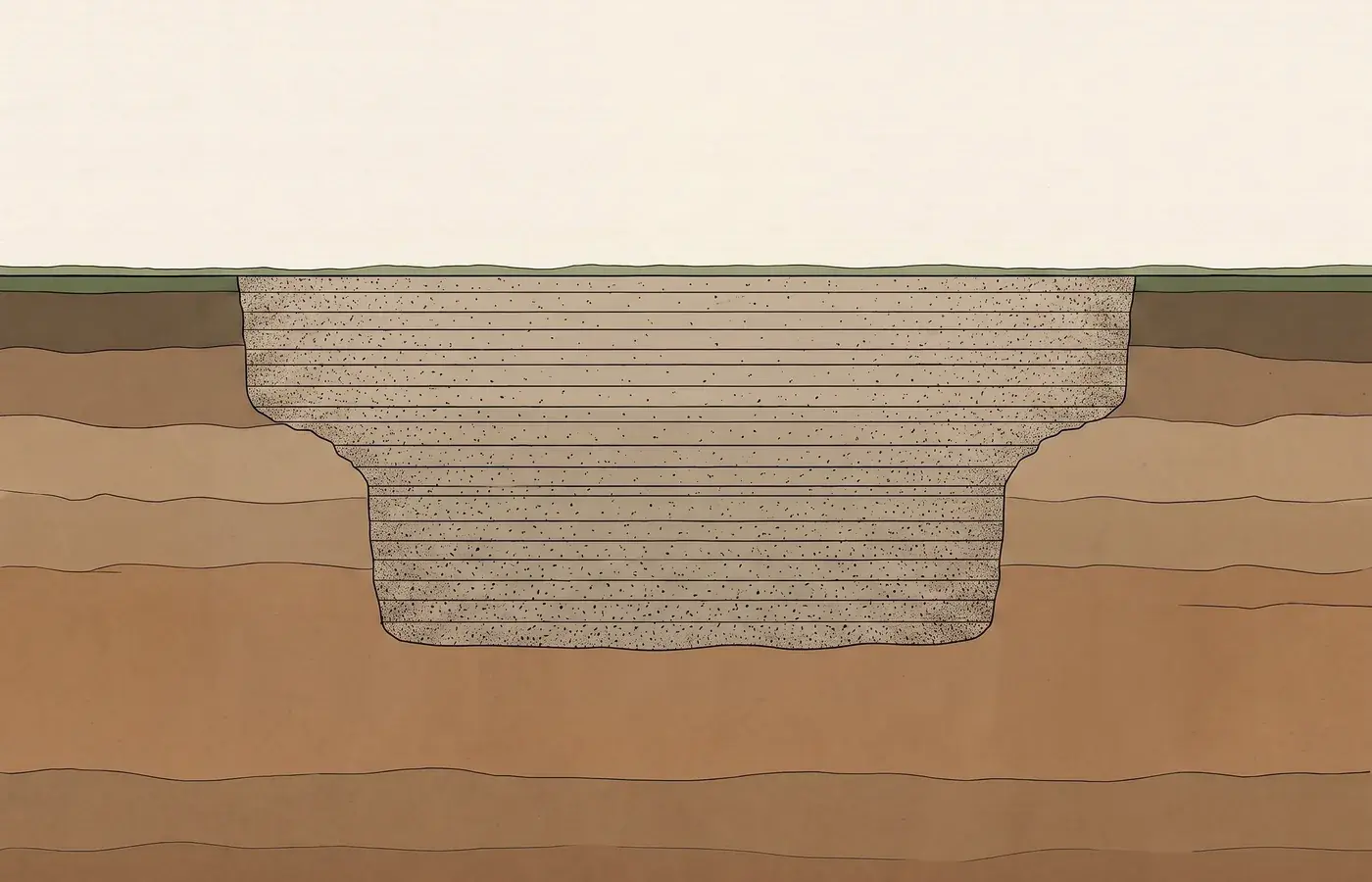
Plate 01—Full Removal
How is a concrete or gunite pool removed?
Short answer
Concrete and gunite pool shells are reinforced with steel rebar and behave identically for demolition purposes, whether the concrete was sprayed on (gunite or shotcrete) or poured into forms. Because the shell is structural and rebar-reinforced, breaking it takes a hydraulic breaker plus a separate rebar-cutting step, and a partial fill-in leaves a large permanent concrete structure in the ground.
Gunite and poured concrete crack the same way once you swing a breaker at them. The rebar is what slows the job down.
Gunite, shotcrete and poured concrete are the same problem
Gunite is dry-mix concrete sprayed at high pressure over a rebar cage; shotcrete is the wet-mix version of the same idea. Poured or formed concrete shells are less common in this region’s backyards but cure into the same reinforced structure once the forms come off.
For demolition purposes, none of that history matters. Once any of these has cured, it’s rebar-reinforced concrete, and it comes apart the same way regardless of which method built it.
Rebar is why this needs different equipment
Plain concrete fractures fairly predictably under a hydraulic breaker attachment. Rebar doesn’t break that way — it bends and tears — so once the concrete around it is broken away, the steel has to be cut or pulled out as a separate step.
That second step is what actually separates a reinforced pool shell from something like an unreinforced patio slab, and it’s the main reason gunite removal needs different, heavier equipment than a plain concrete tear-out.
The bond beam is the toughest part of the shell
The bond beam is the reinforced band that runs around the top of the pool wall. It’s generally thicker and more heavily reinforced than the wall below it, because it carries the coping and ties the top of the walls together into one continuous ring.
On a partial fill-in, where the upper section of the shell comes out and the rest stays, the bond beam is usually the single hardest section to break through — which is part of why where that cut line falls is a real decision, not a formality.
Worth Knowing
Why the partial-vs-full decision matters most on this material
Of the pool types we remove, concrete and gunite are the material most often left in the ground on a partial fill-in. The floor and lower walls stay in place as a permanent reinforced structure, opened only with drainage holes and buried under compacted fill.
On a fiberglass or vinyl-lined pool, what gets left behind after a partial is comparatively minor. On gunite, it’s a slab-sized structure that sits under that yard indefinitely — which is exactly why anyone weighing a future structure over the footprint should treat full removal as the starting question, not an upgrade. We ask about future plans at the site walk before recommending either option.
Next step
Ready to find out what your property needs?
A site walk is where an accurate scope starts — access, shell type, depth, utilities and what you want the ground to do afterwards.
At A Glance
Partial fill-in vs. full removal on a concrete or gunite shell
| What happens | Partial fill-in | Full removal |
|---|---|---|
| Floor and lower walls | Stay in the ground as permanent reinforced concrete | Broken out and hauled off with the rest of the shell |
| Bond beam | Generally broken through near the top of the wall | Removed in full along with the rest of the structure |
| Drainage | Holes broken through the remaining shell so water doesn’t pool | Not applicable — no shell remains to hold water |
| What the footprint can become | Open-yard uses with no structure planned | Generally the starting point if a future structure may go on the footprint |
| Material hauled off site | Upper shell only | Entire shell, floor included |
Source: CalRecycle, Construction & Demolition model ordinance guidance (opens in a new tab)Verified August 22, 2026. Permit requirements change — confirm with the department before relying on this for your property.
Breaking, loading and hauling reinforced concrete
The breaker fractures the shell in sections, the exposed rebar is cut or pulled from the broken concrete, and the material is loaded — by excavator bucket or grapple — into dump trucks and moved off the property. A full removal repeats that sequence across the entire footprint, floor included, rather than stopping at the upper walls.
As with any excavation on the property, utility locating comes first: California law (Government Code §4216) requires notifying 811 before digging, with excavation legal two working days after that notification. A full removal here moves a genuinely large volume of broken concrete off site — more than most owners picture, because a shell that reads as a thin surface from pool-side is a continuous structure below.
Where the broken concrete goes
Broken concrete generally isn’t just landfilled. It can go to a concrete or aggregate recycling facility and get crushed into base rock or aggregate rather than buried, and California’s CALGreen code sets a 65% diversion baseline for construction and demolition debris statewide. Consistent with that, broken concrete gets routed toward recycling rather than disposal wherever the local facility network supports it.
Plaster, pebble or tile finish — and the deck around it
The interior finish — plaster, pebble aggregate or tile — is a cosmetic layer over the structural shell, and it doesn’t change how the shell itself comes out. Tile debris and waterline trim do add to what gets hauled, but they don’t change the demolition method underneath.
Coping, the cap around the pool’s edge, and the surrounding concrete deck are usually tied into or poured against the bond beam. On a full removal they typically come out as part of the same scope rather than being treated as a separate project.
Access matters more here than on any other material
Concrete and gunite generate the heaviest per-load hauling of any pool type we remove, so equipment size and truck access are bigger constraints on this material than on fiberglass, vinyl or above-ground jobs.
Side-yard width, gate clearance, overhead lines and how close a dump truck can get to the excavation all affect which equipment fits and how the job sequences — exactly what we’re looking at during the site walk, before any of it gets scheduled.
Next step
Ready to put a number on your property?
Every answer above changes with access, shell type, depth and what you want the ground to do afterwards. The site walk is what settles them.
Questions On File
Common questions.
Not for demolition purposes. Gunite and shotcrete are both sprayed concrete — dry-mix and wet-mix versions of the same application method — built over a rebar cage, and poured or formed concrete shells cure into the same reinforced structure. Once any of these has cured, it behaves the same way under a breaker and needs the same separate step to cut or pull the rebar. The terms describe how the shell was built, not what removing it requires.
Start With The Site
Tell us about the pool.
An accurate scope starts with the property: access, shell type, depth, utilities and what you want the ground to do afterwards. Send the basics and we will set up a site walk.
Send the basics
Four required answers. Add detail only if it helps.
Walk the property
We confirm access and the scope on site.
Get it in writing
Recommended option, sequence and what happens next.
Still researching the work? Read the complete pool removal service overview.
No obligation, no pressure
Request a site estimate.
Start with the property and what you want the ground to do afterwards. We will follow up to arrange the site walk and confirm the scope.
Read Next
Related reading.
Fiberglass pool removal
A one-piece shell comes out a completely different way.
Vinyl-liner pool removal
Mixed materials, and usually more than one disposal stream.
Partial or full removal
On a gunite shell this is the decision with the longest consequences.
Backfill and compaction
What replaces all that concrete, and how it gets placed.
What pool removal costs
Weight and access drive the number harder on this material than any other.
Where we work
27 communities, each with its own permit path for a demolition.