Cost Drivers
Pool removal cost depends on your yard, not a zip code average.
There’s no honest flat number for pool removal. Real cost comes from access, pool material, size, what’s under the decking, and how much dirt moves on and off your property. This page breaks down every driver so you can read any estimate and know what you’re paying for.
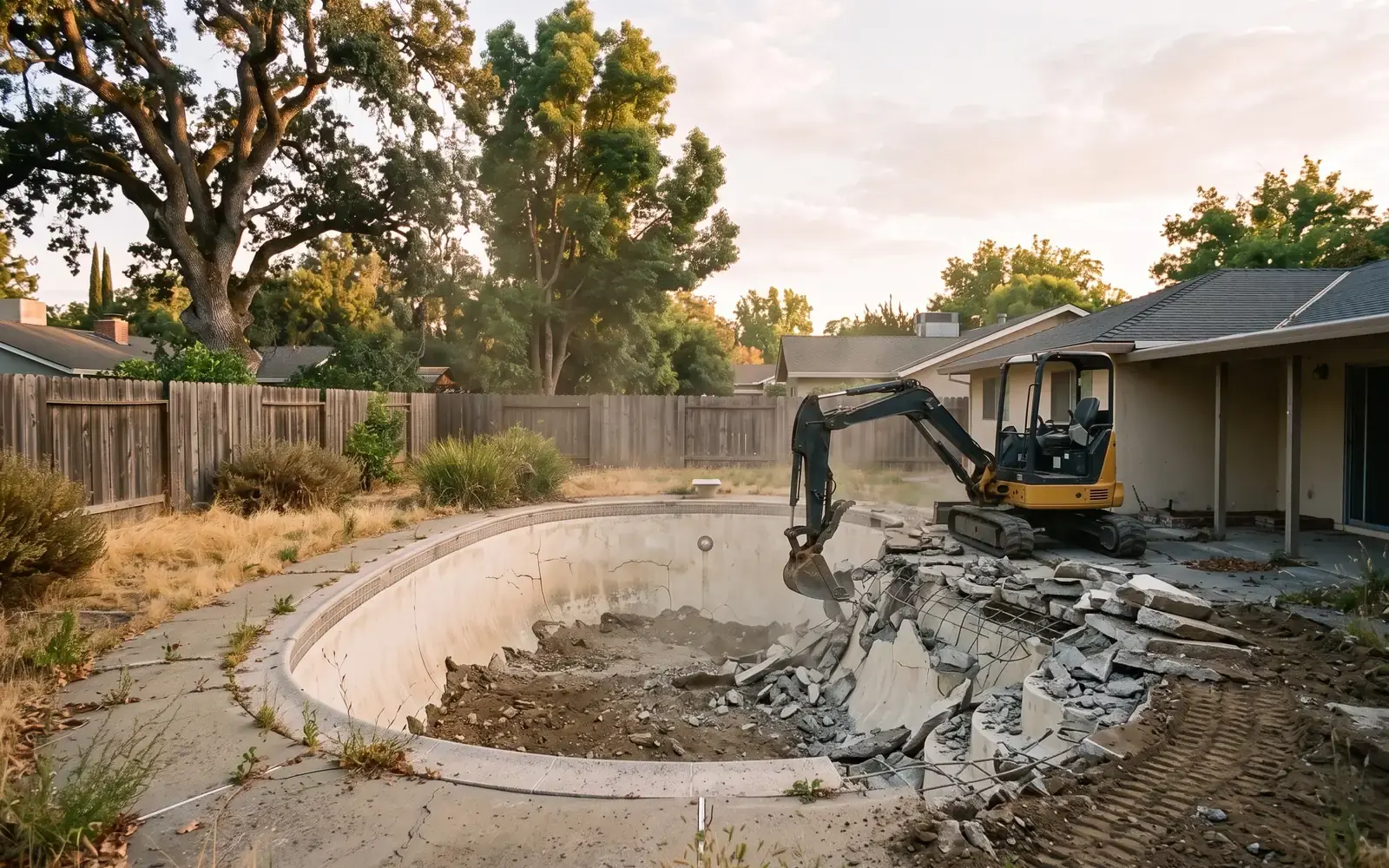
Plate 02—Removal
How much does pool removal cost in Sacramento?
Short answer
Pool removal cost is driven by access, pool material and size, how much concrete and equipment come out, how much fill has to come in, and whether the job is a partial fill-in or a full removal. Two similarly sized pools can cost very differently once one needs a crane over a fence and the other has a truck-width gate. There’s no reliable flat rate. Get a site-specific estimate.
Why there is no price range on this page
Because we have not published one, and we would rather say so than print a range wide enough to be meaningless. Two pools of the same size on the same street can differ substantially once you account for how equipment gets in, what the shell is made of, how much material has to leave, how much fill has to come in and what the yard has to look like when we are done.
What you can do with this page instead: read any estimate you receive against the drivers below, and ask the questions on this list so two quotes are actually describing the same job. A number without a scope attached is not an estimate.
Access decides more of the price than pool size. A small pool with bad access can cost more than a big one with easy access.
Why won’t you just give me a price?
Every pool removal company that publishes a flat number or a generic range without seeing your property is guessing, or anchoring you to a lowball figure they’ll walk back once someone actually looks at the yard. Access alone can double the labor on an otherwise average job, and access doesn’t show up on a satellite photo.
The honest version is less satisfying but more useful: cost comes from a specific set of variables, and once you understand them, you can read any estimate you get, from us or anyone else, and know whether it accounts for what your property actually requires.
Access is usually the biggest swing factor
Pool removal equipment has to get from the street to the pool and back out again, along with the material coming out and the fill going in. A side yard too narrow for an excavator, a gate that won’t clear equipment width, or a pool set behind a fence with no drivable path all mean smaller machinery, more hand labor, or both.
Overhead power lines near the work area can restrict crane or boom reach. A pool with no direct access at all sometimes means staging material in the street or bringing in a smaller machine that takes longer to do the same job. None of this shows up in a listing photo, which is exactly why the same size pool can price very differently two doors down.
What to check for access
- Gate and side yard width relative to equipment
- Overhead power lines near the pool or the equipment path
- Whether machinery can reach the pool directly, or has to work from a distance
- Whether material staging in the street is needed
Pool material changes how hard it is to remove
Not all pools come apart the same way. Gunite and shotcrete pools are steel-reinforced concrete shells and generally take more time and heavier equipment to break up than a fiberglass shell or a vinyl-liner pool’s wall system.
Above-ground pools are the simplest structure to remove but still involve the same backfill and compaction work if the area below grade needs to be brought back to level. Fiberglass shells often come out closer to intact, which changes the hauling approach. Vinyl-liner pools have a wall structure and liner to deal with separately from the excavation itself.
Removal difficulty by material
- Concrete/gunite: reinforced shell, generally the most demolition-intensive
- Fiberglass: rigid shell, often removed closer to intact
- Vinyl-liner: liner and wall structure handled separately from the excavation
- Above-ground: simplest structure, but the ground below still needs backfill and grading
Size and depth set the volume of the job
A bigger, deeper pool means more concrete or shell material to break up and haul off, and more fill to bring back in to replace it. That’s a straightforward volume relationship, but it’s not the only one. A small, deep spa-style pool can require as much excavation depth as a much larger, shallower pool.
Depth also affects how the excavation is sequenced, particularly on a full removal where the entire shell comes out and the hole has to be backfilled and compacted from the bottom up.
Worth Knowing
Decking, plumbing, electrical and equipment come out too
The pool shell is rarely the only thing being removed. Surrounding concrete decking, a paved patio tied into the pool coping, retaining walls built into the pool structure, and any steps or benches poured as part of the shell all add demolition scope beyond the water-holding structure itself.
Below and around the pool there’s usually plumbing, electrical conduit to pool equipment, and sometimes a gas line if a heater was installed. The equipment pad, filter and pump, and any built-in features need to be disconnected and removed as part of the scope, not treated as an afterthought once the shell is already gone.
Scope items beyond the shell itself
- Surrounding decking and patio concrete tied into the pool
- Steps, benches or retaining walls poured as part of the shell
- Plumbing lines and electrical conduit to pool equipment
- Gas line disconnection if a heater was installed
- Equipment pad, filter and pump removal
Next step
Ready to find out what your property needs?
A site walk is where an accurate scope starts — access, shell type, depth, utilities and what you want the ground to do afterwards.
At A Glance
How each cost driver tends to move the price, low side versus high side.
| Criterion | Tends toward less | Tends toward more |
|---|---|---|
| Access | Wide gate, clear path, equipment drives straight to the pool | Narrow side yard, tight gate, overhead lines, or no direct equipment access |
| Pool material | Vinyl-liner or above-ground | Gunite or shotcrete concrete shell |
| Size and depth | Smaller, shallower pool | Larger or unusually deep pool |
| Decking and surrounding concrete | Minimal decking tied to the pool | Extensive patio, steps or retaining walls built into the shell |
| Removal type | Partial fill-in | Full removal with complete shell haul-off |
| Material in and out | Less debris to haul, less fill to import | Large excavation requiring many truckloads each way |
| Future use of the footprint | Staying open yard space | Possible future structure, which usually requires full removal and engineered fill |
Source: California Contractors State License Board, Home Improvement Contracts — What Is A Contract (opens in a new tab)California Contractors State License Board, Licensing Classifications — C-21 Building Moving/Demolition (opens in a new tab)Verified August 22, 2026. Permit requirements change — confirm with the department before relying on this for your property.
What leaves the property, and what has to come in
Full removal means the entire shell leaves as debris, hauled off site. Partial fill-in leaves the lower portion of the shell in place and removes less material, which is one reason it’s often the lower-cost option. Either way, whatever comes out has to be trucked somewhere, and trucking has its own cost independent of the demolition itself.
On the way back in, approved fill material has to be brought onto the property and compacted in layers, called lifts, rather than dumped in loose. The volume of fill needed roughly matches the volume of pool that was removed, so a bigger excavation means more truckloads of fill in addition to more truckloads of debris out.
Permit path and final grading
Pool removal generally requires a permit from your local building department, and the permit process is its own cost and timeline variable. Requirements differ by city and county, and what your jurisdiction asks for, inspections, drainage specifications, fill documentation, isn’t something a contractor sets. It’s set by the building department reviewing your permit.
Once the fill and compaction work is done, the site still needs final grading so water moves away from the house and other structures rather than pooling against a foundation. That grading work is part of finishing the job, not a separate add-on, and it should be scoped into any estimate you’re comparing.
Why partial removal usually costs less, and why that’s not automatically the right call
Partial fill-in generally costs less than full removal because less shell material leaves the property and the excavation is shallower. For a yard that’s staying open space, lawn, garden, patio, that can be the more efficient option.
It’s the wrong call if there’s any real chance of building over the old pool footprint later, an ADU, a room addition, a structure with a foundation. Building over ground that still has pool shell in it, or fill that wasn’t engineered for a structural load, is a problem you’d rather not discover after the fact. If a future build is even a possibility, that’s a conversation to have before deciding which removal type to price out, because it can change which option makes sense regardless of the up-front cost difference.
How to make two estimates actually comparable
The reason two pool removal quotes can look wildly different isn’t always that one contractor is overcharging. Often they’re pricing different scopes of work. Before comparing numbers, make sure you’re comparing the same job.
Questions to ask so estimates line up
- Does the price include hauling debris off the property, or is that billed separately?
- Is fill material and compaction included, or scoped as an add-on?
- Does the estimate include final grading, or does the yard get left rough?
- Is permit coordination included, and who is submitting the paperwork?
- What access does the estimate assume, and did the contractor actually see the side yard and gate?
- Is the quote for partial or full removal, and does that match what you asked for?
- What’s the payment schedule, and does the deposit comply with California’s down payment limit?
California limits what a contractor can ask for upfront
This one isn’t a cost driver, it’s consumer protection, and it’s worth knowing before you sign anything. Under California law, the down payment on a home improvement contract, which includes pool removal, cannot exceed the lesser of $1,000 or 10% of the contract price, excluding finance charges. There are no exceptions for special-order materials.
According to the Contractors State License Board (CSLB), a written payment schedule has to appear in the contract, and payments after the deposit can’t exceed the value of work actually completed. If an estimate asks for a deposit larger than that limit, that’s worth asking about directly before you sign, regardless of who you’re getting the quote from.
Next step
Ready to put a number on your property?
Every answer above changes with access, shell type, depth and what you want the ground to do afterwards. The site walk is what settles them.
Questions On File
Common questions.
There’s no single number that applies to every property, and any contractor who quotes one without seeing your yard is guessing. Cost is set by access, pool material, size and depth, how much decking and equipment come out with it, how much debris leaves the property, how much fill has to come in, and whether you’re doing a partial fill-in or a full removal. The only way to get an accurate figure is a site visit, because access alone can change the price more than pool size does.
Start With The Site
Want a number for your yard?
The site walk is where an accurate number comes from — access, depth, utilities, slope and what is actually in the ground. It is free, and you get the scope in writing.
Send the basics
Four required answers. Add detail only if it helps.
Walk the property
We confirm access and the scope on site.
Get it in writing
Recommended option, sequence and what happens next.
Still researching the work? Read the complete pool removal service overview.
No obligation, no pressure
Request a site estimate.
Start with the property and what you want the ground to do afterwards. We will follow up to arrange the site walk and confirm the scope.
Read Next
Related reading.
Partial or full removal
The single biggest lever on cost, and it is not purely a budget decision.
Permits by jurisdiction
Which department covers you, and what each one asks for.
Backfill and compaction
Imported fill and compaction are cost drivers you cannot see from the street.
Questions to ask a contractor
How to make two estimates actually comparable before you sign one.
Concrete and gunite removal
The heaviest shell material, and the one that moves the most weight.
Above-ground removal
A genuinely different job, with a genuinely different cost shape.