A Different Job
Above ground pool removal.
There’s no shell to demolish here — an above-ground pool comes apart, it doesn’t get broken up. That makes this a genuinely different job from every other in-ground pool type, and usually the fastest one.
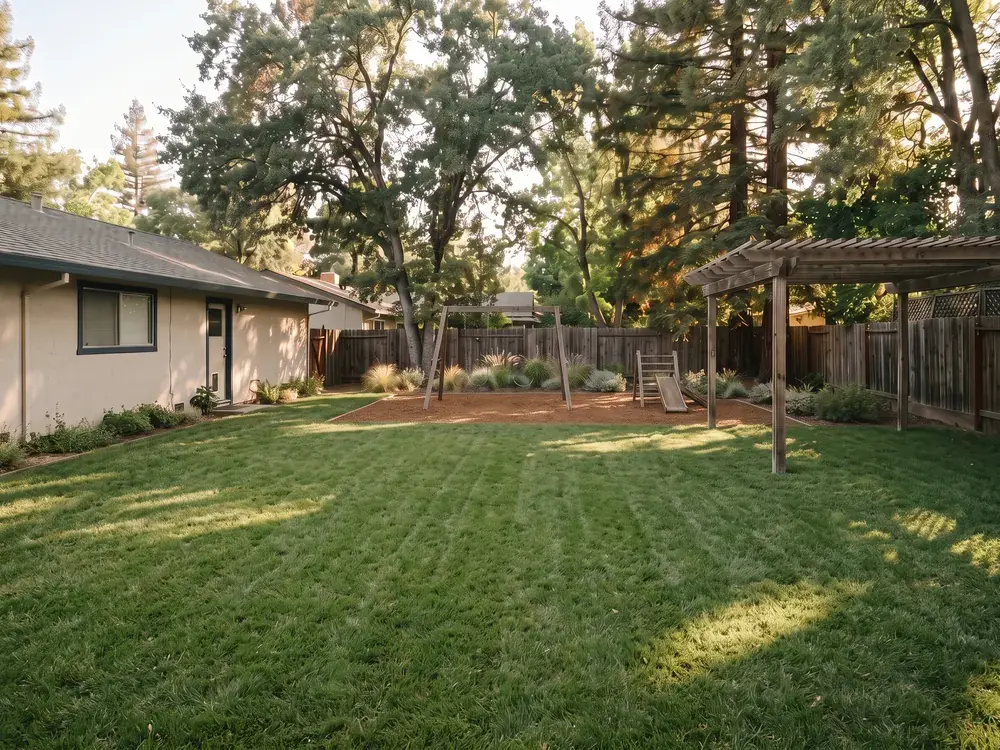
Plate 01—Play Space
How is an above-ground pool removed?
Short answer
Above-ground pool removal is disassembly and haul-off, not demolition: the wall panels, top rail and liner are taken apart and loaded out. The real work is usually what’s underneath — a sand base, a concrete pad, or pavers — and whether a permit applies generally depends on the jurisdiction and on what’s attached to the pool, which your local building department decides.
Nobody calls about the pool ring. They call about the dead circle of dirt it leaves behind.
This is disassembly, not demolition
An above-ground pool wall is generally sheet steel or resin panels bolted together in a ring, held upright by a top rail and uprights, with the liner draped inside rather than structurally bonded to anything.
There’s no reinforced shell and nothing to break — the job is unbolting the ring, taking down the framing, and hauling the pieces off the property. That’s a fundamentally different scope than any in-ground removal on this site.
What’s underneath the pool is the real question
Above-ground pools are set on a sand base, a poured concrete pad, or sometimes pavers or concrete blocks, and which one is there changes the job significantly.
A sand base is straightforward to deal with once the pool is gone. A concrete pad is a poured slab, and breaking that out is frequently more work than removing the pool itself — it’s the part of an above-ground job that most resembles the in-ground removals we do, and it’s also where utility locating through 811 matters if the pad ever gets broken up rather than just left in place.
The footprint the pool leaves behind
Years of a pool ring blocking sun and rain over one patch of yard generally leaves dead, compacted ground behind once it’s gone, and a sand base that’s settled over time can leave a shallow depression rather than a level surface.
An empty circle where the pool used to be is not the same thing as a usable piece of yard.
Worth Knowing
Decking and surrounds are usually their own task
A lot of above-ground installs picked up a wood deck, a walkway, or some other built-up surround leading up to the pool over the years, and those structures are generally a separate demolition task, sized on their own rather than folded automatically into the pool disassembly.
Worth flagging at the site walk so it’s part of the scope from the start, rather than a surprise once the pool itself is already gone.
Next step
Ready to find out what your property needs?
A site walk is where an accurate scope starts — access, shell type, depth, utilities and what you want the ground to do afterwards.
At A Glance
How an above-ground pool removal generally breaks down
| Criterion | What happens | What leaves the property |
|---|---|---|
| Water and liner | Pool is drained and the liner is removed | Liner — general debris |
| Wall panels and framing | Ring is unbolted and taken down section by section | Steel or resin panels — scrap metal or general debris depending on material |
| Base | Sand base is cleared, or a concrete pad is broken out if present | Sand, regraded on site, or broken concrete routed to recycling if a pad was present |
| Footprint | Dead, compacted ground is reworked, leveled and reseeded or resodded | Nothing — this stage restores rather than removes |
Source: CalRecycle, Construction & Demolition model ordinance guidance (opens in a new tab)Verified August 22, 2026. Permit requirements change — confirm with the department before relying on this for your property.
Getting the yard back to usable, not just empty
Taking the pool away leaves an empty footprint; making that ground usable again generally means reworking the dead patch — breaking up compacted soil, amending it, leveling or regrading to match the surrounding yard, and reseeding or resodding.
Skipping that step is why some DIY above-ground removals leave a visible dead ring in the lawn for years afterward.
Is a permit required?
This is a genuinely different question than it is for an in-ground pool. An in-ground demolition removes a permanent structure and is generally treated as permitted demolition work. An above-ground pool is a freestanding, non-permanent structure, and whether removing one requires a permit depends on the jurisdiction and on what’s attached to it — a poured pad, a built deck, electrical for a pump or heater, and similar factors can change the answer.
We don’t promise a specific requirement or exemption here. Your local building department decides what applies to your property, and we tell you what we learn when we coordinate the paperwork.
Usually the fastest job we do
With no shell to break and generally far less excavation than an in-ground removal, above-ground disassembly and haul-off is frequently the quickest project on this site — right up until there’s a concrete pad involved, at which point the timeline starts to look more like the in-ground jobs it otherwise doesn’t resemble.
Next step
Ready to put a number on your property?
Every answer above changes with access, shell type, depth and what you want the ground to do afterwards. The site walk is what settles them.
Questions On File
Common questions.
No — it’s a different kind of job entirely. In-ground removal is demolition: breaking apart a shell, whether concrete, fiberglass or a vinyl-lined structure. Above-ground removal is disassembly: unbolting steel or resin wall panels, taking down the framing, and hauling the pieces off. There’s no shell to break and generally much less excavation, which is why above-ground jobs tend to move faster than any in-ground option.
Start With The Site
Got an above-ground pool to lose?
It is usually the fastest job we do, and the site walk is still where the scope gets set — mostly because of whatever is underneath it.
Send the basics
Four required answers. Add detail only if it helps.
Walk the property
We confirm access and the scope on site.
Get it in writing
Recommended option, sequence and what happens next.
Still researching the work? Read the complete pool removal service overview.
No obligation, no pressure
Request a site estimate.
Start with the property and what you want the ground to do afterwards. We will follow up to arrange the site walk and confirm the scope.
Read Next
Related reading.
Concrete and gunite removal
What an in-ground demolition involves, for comparison.
Permits by jurisdiction
The permit question runs differently for above-ground. Start with your department.
Backfill and grading
Less filling, more grading — the footprint still has to drain.
What pool removal costs
A different cost shape from an in-ground removal, driven mostly by the base.
What to do after removal
Compacted dead ground does not become lawn on its own.
Where we work
27 communities across four counties.