The Half You Cannot See
The backfill and compaction work is what actually prevents problems later.
Anyone can dump dirt in a hole. What keeps a filled-in pool from becoming a soft spot, a sinking patch of lawn, or a drainage problem down the road is what happens below grade: the fill material, how it’s compacted, and where the water is told to go.
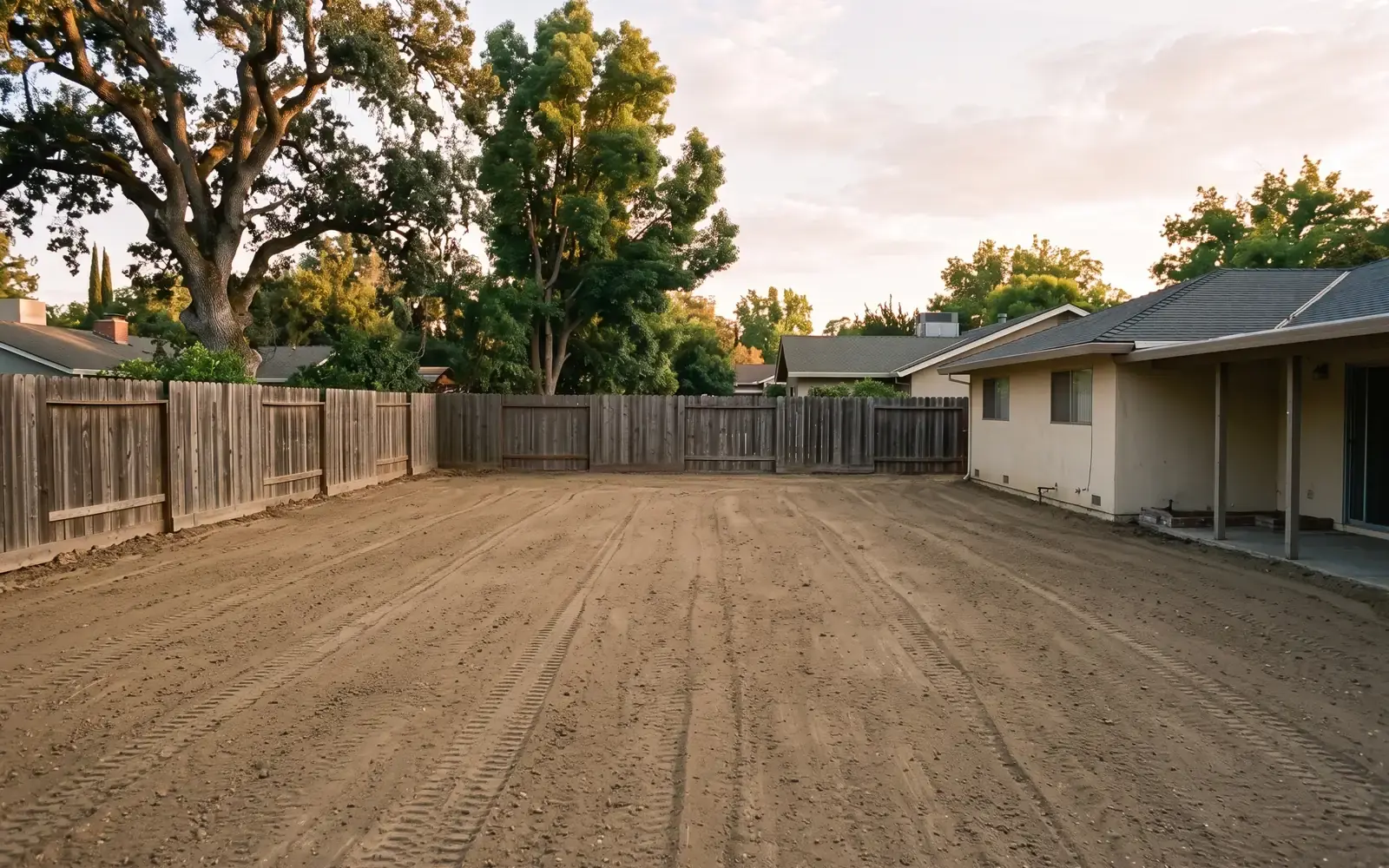
Plate 03—Final Grade
How is a removed pool backfilled and compacted?
Short answer
Proper pool backfill uses approved fill material compacted in layers, not loose dirt dumped in all at once. A partial fill-in also needs drainage openings cut into the remaining shell, since the pool void is usually the lowest point on the property and water collects there if it can’t drain. Skip either step and the fill settles unevenly, which is why filled-in pools develop soft spots and sinking ground years later.
Loose fill always finds its low spot eventually. Compaction in lifts is what buys you a lawn that doesn’t sink.
What 'approved fill’ means, and why it’s not just dirt
Not every material that can physically fill a hole is suitable for backfilling a pool excavation. Approved fill generally means soil that’s free of organic material, debris, construction waste and oversized rock, material that will compact predictably and hold its volume over time rather than decomposing, settling, or leaving voids as it breaks down.
This matters because whatever goes into that excavation is what your lawn, patio, or future landscaping sits on top of. Fill with buried debris, tree stumps, or construction scraps in it will settle unevenly as those materials eventually compress or decay, and that unevenness shows up on the surface as a soft spot or a dip, sometimes years after the crew has left.
Why fill goes in compacted layers, not all at once
Compacting in lifts means the fill is placed in shallow layers, and each layer is mechanically compacted before the next one goes in. That’s different from dumping fill into an excavation all at once and letting it settle on its own, which is how loose fill ends up.
Loose fill has air pockets between the soil particles. Over time, gravity, rainfall and normal ground vibration compress those pockets out, and the fill loses volume from the top down. If the fill was placed loose and never mechanically compacted, that settling happens on your property, on your timeline, instead of happening under controlled conditions during the job.
A pool void is the lowest point on the property
Before removal, a pool sits below the surrounding grade by design, that’s what makes it a pool. Once the water and the shell interior are gone, that depression is still the lowest point on the lot relative to everything around it, at least until it’s properly filled and graded.
Water follows grade. Rain, irrigation runoff and any water moving across the yard is going to find the lowest available point unless something directs it elsewhere. If the fill settles unevenly, or the surrounding grade isn’t sloped to move water away from that former low point, it becomes exactly the spot where water collects, right where you don’t want standing water: near a foundation, under a patio, or under a new lawn.
Drainage openings: the difference between a fill-in and a dumped hole
On a partial fill-in, the lower portion of the pool shell stays in the ground. Left intact, that shell would act like a bowl, holding any water that gets into the fill above it instead of letting it drain into the surrounding soil, which is why drainage openings get cut into the remaining shell before fill goes in.
Those openings let water that reaches the base of the excavation continue moving into the native soil below and around the old shell, instead of pooling against the inside of a structure that was built to hold water in the first place. Skip that step and you’ve built a bathtub under your lawn, filled with dirt, but still shaped to collect water underneath.
Worth Knowing
Fill for open yard use versus fill engineered for a future structure
Some building departments draw a distinction between fill placed for general yard use, lawn, planting, a patio, and fill that’s engineered to eventually carry a structure with a foundation, like an ADU or a room addition. This isn’t a single statewide standard. It’s a distinction individual jurisdictions make when they review a permit application, and the specifics come from that department, not from a uniform code that applies everywhere.
Engineered fill for a future structural load often involves a soils report, specific compaction testing, and sign-off from a geotechnical professional, requirements that go beyond what’s needed for fill that’s only ever going to carry a lawn. If there’s any chance you’ll build over the old footprint down the road, that’s a conversation to have with your building department and your contractor before the fill goes in, not after.
Next step
Ready to find out what your property needs?
A site walk is where an accurate scope starts — access, shell type, depth, utilities and what you want the ground to do afterwards.
At A Glance
Common symptoms after a pool fill-in, and what usually causes them.
| Criterion | Likely cause |
|---|---|
| Soft or spongy spot in the lawn | Loose or under-compacted fill settling under its own weight |
| Shallow depression that gets lower each season | A lift that wasn’t compacted before the next layer went on top of it |
| Water pooling against the house after rain | Final grade sloping toward the structure instead of away from it |
| Standing water on the surface after normal rainfall | Drainage openings blocked or insufficient, or grade too flat to move water off the area |
| New cracks in a patio or walkway over the old footprint | Fill still settling before the hardscape above it was ready to carry real load |
| Musty smell or damp soil near the old pool location | Groundwater or rain collecting in the old excavation instead of draining into surrounding soil |
Source: City of Elk Grove Building Safety Inspection & Permits, Swimming Pool Demolition Permit (opens in a new tab)California Department of Housing and Community Development, Accessory Dwelling Unit Handbook (opens in a new tab)Verified August 22, 2026. Permit requirements change — confirm with the department before relying on this for your property.
Final grade: moving water away from the house
Once the excavation is filled and compacted, the surface needs to be graded, meaning shaped and sloped, so water moves away from the house and any other structures on the property instead of pooling against them. That’s true whether the old pool was near the house or out in the middle of the yard, because grading affects how water moves across the whole property, not just the filled area.
Final grade is part of finishing the job correctly, not a cosmetic step. A yard that looks level right after the work but wasn’t actually graded to shed water away from the foundation is a yard that’s set up for a drainage problem the first time it rains hard.
What settlement looks like when it goes wrong
When fill wasn’t compacted properly, or was placed loose instead of in lifts, the signs are usually visible on the surface: a soft or spongy spot in the lawn, a shallow depression that seems to get a little lower each season, cracks in a patio or walkway poured over or near the old footprint, or water pooling in one spot after rain when the rest of the yard drains normally.
There’s no way to promise settlement won’t happen or to guarantee a precise timeline for it. What tends to be true is that problems show up earliest during the first one or two rainy seasons after the work, when saturated soil reveals any voids or under-compacted areas that dry ground was hiding. That’s also the window when it’s easiest to have an issue assessed and addressed before it affects anything built nearby.
One city’s pool demolition permit, as an example of how specific this gets
How detailed these requirements get, and who sets them, varies by jurisdiction. As one example, the City of Elk Grove’s Swimming Pool Demolition Permit calls for removing the bond beam and gunite to a minimum depth of 18 inches, capping all drain lines, and cutting at least two openings in the remaining pool bottom, one at the deep end and one at the shallow end, each a minimum of three feet by three feet.
That’s Elk Grove’s specification, not a statewide rule, and it’s a useful illustration of the kind of detail a local building department can require: exact depths, exact opening counts and sizes, specific handling of drain lines. Your jurisdiction’s requirements may look similar or may differ; the only way to know for certain is to check with your local building department directly.
What you can reasonably check on the ground afterward
After the work is done and the yard has had a chance to go through a rain cycle or two, it’s reasonable to walk the area and look for a few specific things: any spot that feels noticeably softer underfoot than the surrounding lawn, any area where water sits after rain longer than the rest of the yard, and any new cracking in nearby hardscape that wasn’t there before.
None of that is a guarantee something’s wrong. Ground settles a little as a matter of course, and freshly placed lawn or planting needs its own time to establish. But a soft spot that’s getting more noticeable over time, or water consistently collecting against the house, is worth raising with whoever did the work rather than waiting to see if it resolves on its own.
Next step
Ready to put a number on your property?
Every answer above changes with access, shell type, depth and what you want the ground to do afterwards. The site walk is what settles them.
Questions On File
Common questions.
Approved fill is soil that’s free of organic material, construction debris and oversized rock, material that compacts predictably and holds its volume instead of settling or decaying over time. It’s what goes into the excavation once the pool shell is removed or opened up. Fill that includes buried debris or organic matter will settle unevenly as that material breaks down or compresses, and that unevenness eventually shows up on the surface as a soft spot, a dip, or an area that drains differently than the rest of the yard.
Start With The Site
Want to know what your lot needs?
Fill and drainage are decided by the ground you actually have, not by a general rule. The site walk is where that gets settled.
Send the basics
Four required answers. Add detail only if it helps.
Walk the property
We confirm access and the scope on site.
Get it in writing
Recommended option, sequence and what happens next.
Still researching the work? Read the complete pool removal service overview.
No obligation, no pressure
Request a site estimate.
Start with the property and what you want the ground to do afterwards. We will follow up to arrange the site walk and confirm the scope.
Read Next
Related reading.
How partial fill-in works
Where drainage openings come in, and why they are not optional.
How full removal works
An open excavation is a different fill problem from a capped shell.
Building over a removed pool
Where the fill question stops being about landscaping and starts being about foundations.
What to do after removal
Settlement, the first wet season, and when the ground is ready for what you want on it.
What pool removal costs
Imported fill and compaction are two of the drivers nobody sees from the street.
Permits by jurisdiction
Who sets the fill specification for your address, and what they publish.