Shell Material
Fiberglass pool removal.
A fiberglass shell is one molded piece, not a poured structure, and that changes how it comes out. It’s usually the lightest, fastest removal of the three in-ground pool types — though what surrounds the shell is often the bigger part of the job.
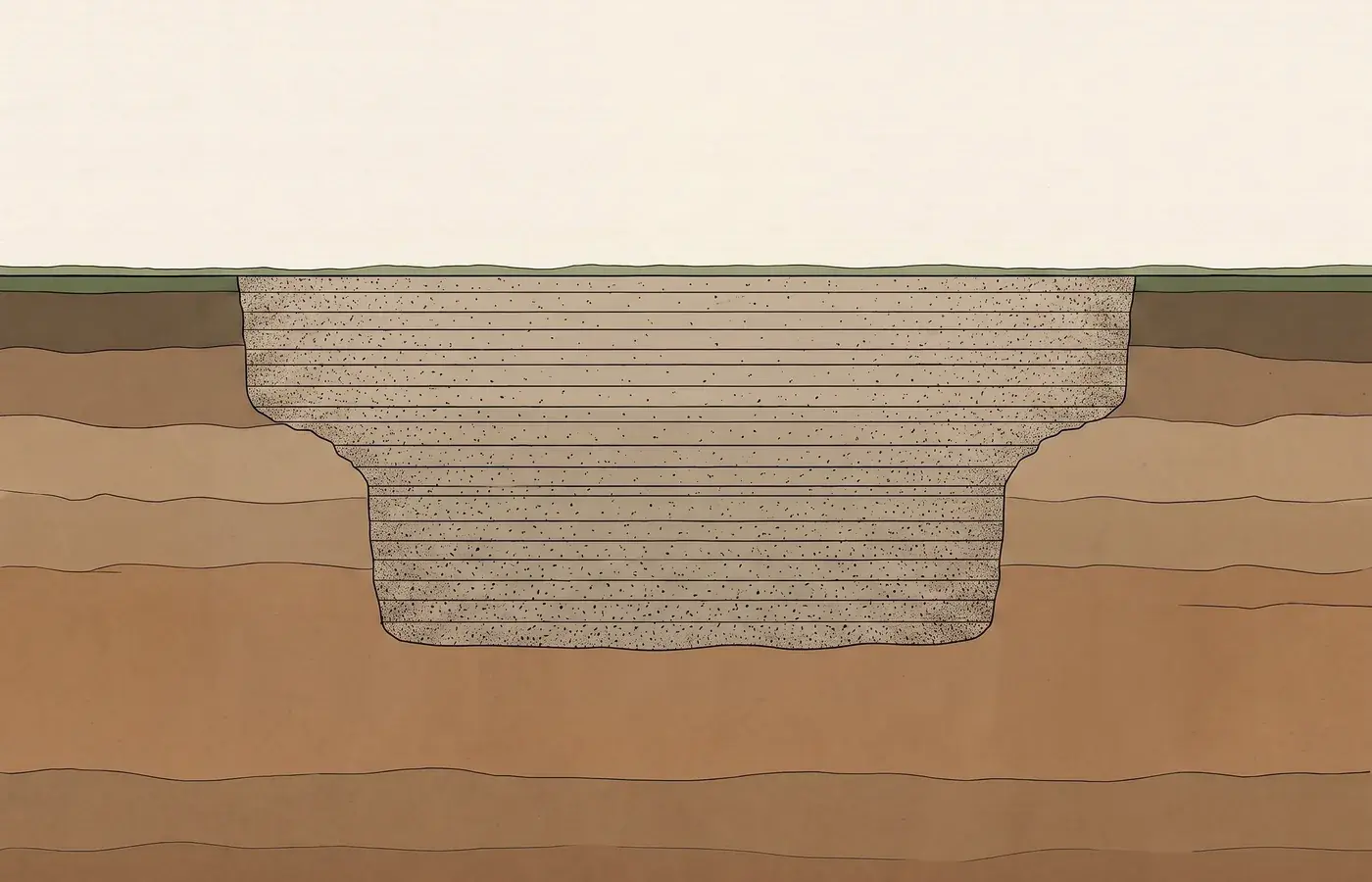
Plate 01—Full Removal
How is a fiberglass pool removed?
Short answer
A fiberglass pool is a single molded shell rather than a reinforced concrete structure, so it can often be cut into sections and lifted out instead of broken apart in place. That generally makes fiberglass the fastest of the three in-ground removal types. What people forget is that the shell usually sits inside a poured concrete bond beam and deck, and those come out separately.
The shell is the easy part. The concrete collar holding it in place is the part people don’t expect.
A fiberglass pool is one molded piece
A fiberglass shell is manufactured off site as a single fiberglass-reinforced composite piece, then lowered into an excavated hole and backfilled around the outside. Unlike gunite or concrete, there’s no rebar cage and no on-site curing — the shell arrives structurally complete.
That’s exactly what makes it come apart differently once it’s time to remove it. There’s no reinforced structure to defeat, just one continuous piece to deal with.
Cut into sections and lifted, not broken up
Because it’s a single continuous shell rather than a reinforced structure, a fiberglass pool can often be cut into large sections with a saw and lifted out with an excavator, rather than pulverized in place the way a concrete shell has to be.
Depending on the shell’s shape and condition it may still need to be broken in places — cutting and lifting is an option, not a guarantee — but it’s an option gunite and concrete shells simply don’t have.
Generally lighter and faster than concrete
A fiberglass shell weighs a fraction of an equivalent volume of reinforced concrete, and without an extensive rebar cage to cut through, demolition once the shell is exposed generally moves faster than a comparable gunite job.
That speed applies to the shell itself. It doesn’t include everything built around it, which is its own scope entirely.
Worth Knowing
The concrete collar and deck people forget about
Most fiberglass pools sit inside a poured concrete bond beam, sometimes called a collar, that anchors the top of the shell and carries the coping and deck loads, plus a surrounding concrete or paver deck.
That concrete didn’t come with the shell, and it doesn’t come out with a cut-and-lift approach — it gets broken out the same way a gunite bond beam does. A fiberglass removal quote that only accounts for the shell is quoting half the job.
Next step
Ready to find out what your property needs?
A site walk is where an accurate scope starts — access, shell type, depth, utilities and what you want the ground to do afterwards.
At A Glance
What comes out of a fiberglass pool, and where it goes
| Component | What it is | Disposal stream |
|---|---|---|
| Molded shell | Single-piece fiberglass-reinforced composite | General construction-and-demolition debris, not the concrete stream |
| Bond beam / collar | Poured, reinforced concrete anchoring the top of the shell | Concrete or aggregate recycling, same as a gunite pool |
| Deck | Concrete or pavers surrounding the pool | Concrete recycling, or reuse if pavers are salvageable |
| Plumbing | PVC lines run through the shell wall | General debris, generally a minor share of the total |
| Pad equipment | Pump, filter, heater and related hardware | Scrap metal or general debris depending on condition |
Fiberglass debris is a different stream than concrete
The composite shell material isn’t accepted at a concrete or aggregate recycler the way broken gunite is, so it moves through general construction-and-demolition debris disposal rather than the concrete recycling stream.
The concrete collar and deck around it, by contrast, can generally go toward concrete recycling the same as any other job — so a single fiberglass removal usually produces two different disposal streams rather than one.
Full removal is often the more straightforward option on fiberglass
Without a large floor slab or an extensive rebar cage to work through, taking the entire shell out is usually less of an escalation from a partial than it would be on concrete.
That doesn’t make full removal free of tradeoffs — it still means more excavation and more backfill than a partial — but the demolition step itself is generally more predictable on fiberglass than on gunite.
Plumbing and equipment
Skimmer lines, the main drain and return lines are plumbed directly through the shell wall and need to be cut and capped as part of the removal, and pad equipment — pump, filter, heater — is disconnected and removed the same as on any pool type.
None of that is specific to fiberglass, but it’s part of the scope regardless of which removal option you choose.
Next step
Ready to put a number on your property?
Every answer above changes with access, shell type, depth and what you want the ground to do afterwards. The site walk is what settles them.
Questions On File
Common questions.
Often, yes, for most of the shell. Because it’s a single molded piece rather than a reinforced concrete structure, a fiberglass shell can generally be cut into large sections with a saw and lifted out with an excavator. Depending on the shell’s shape, condition and how it was set into the ground, some sections may still need to be broken rather than lifted, but cutting and lifting is an option concrete and gunite shells don’t have.
Start With The Site
Tell us about the pool.
An accurate scope starts with the property: access, shell type, depth, utilities and what you want the ground to do afterwards. Send the basics and we will set up a site walk.
Send the basics
Four required answers. Add detail only if it helps.
Walk the property
We confirm access and the scope on site.
Get it in writing
Recommended option, sequence and what happens next.
Still researching the work? Read the complete pool removal service overview.
No obligation, no pressure
Request a site estimate.
Start with the property and what you want the ground to do afterwards. We will follow up to arrange the site walk and confirm the scope.
Read Next
Related reading.
Concrete and gunite removal
The heavier, more common shell — and what usually surrounds a fiberglass pool anyway.
Vinyl-liner pool removal
The third in-ground type, and the one with the most mixed materials.
How full removal works
Often more straightforward on fiberglass than on gunite.
Backfill and compaction
The hole is the same size whatever the shell was made of.
What pool removal costs
Material is one driver among eleven. Here are the others.
Permits by jurisdiction
A demolition permit is a demolition permit, whatever the shell is made of.