Shell Material
Vinyl liner pool removal.
A vinyl-lined pool is the least common of the three in-ground types in this region, and it’s usually the one with the most mixed materials — liner, wall panels, footing and often a concrete collar, all in one hole.
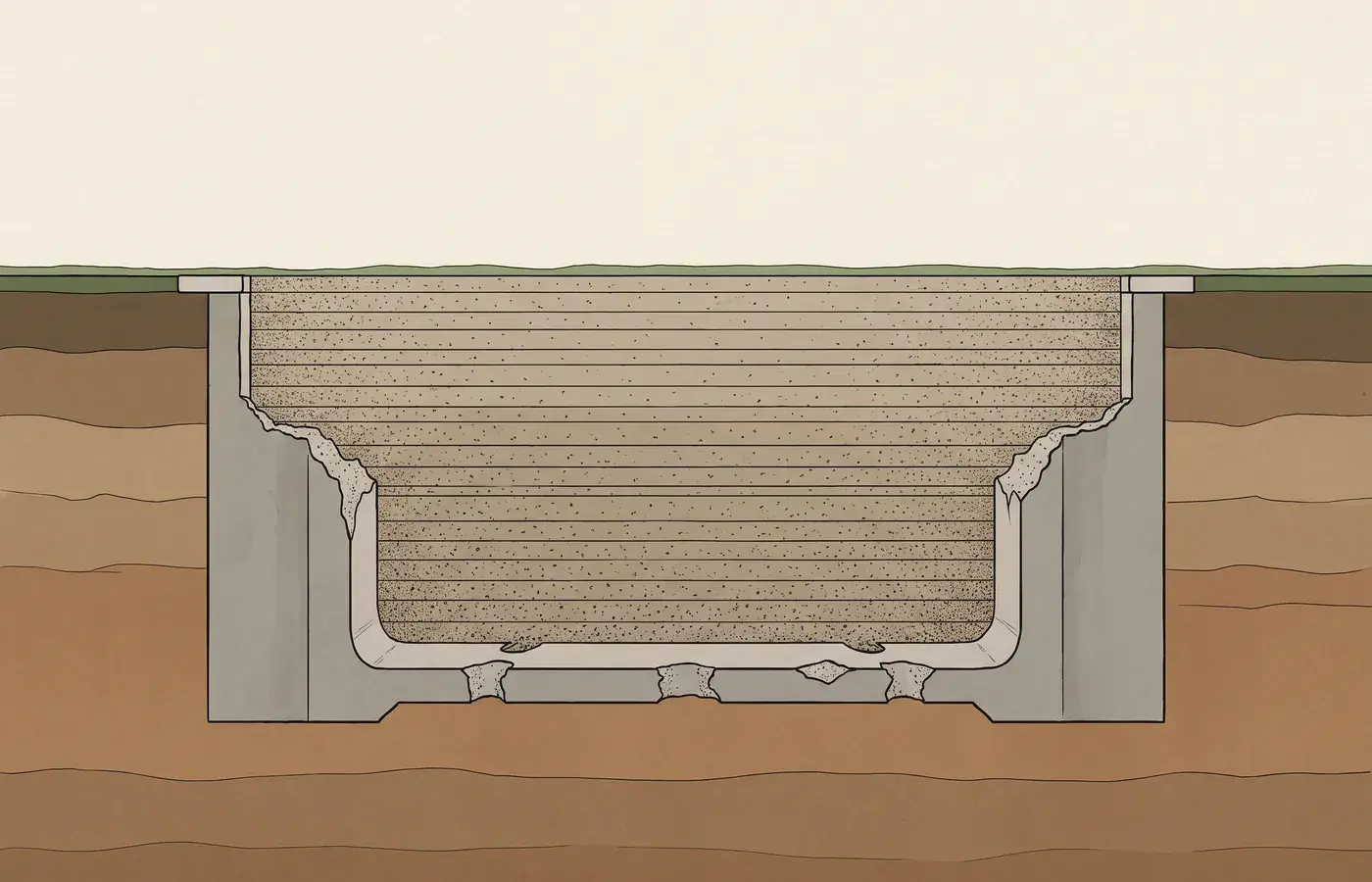
Plate 01—Partial Fill-In
How is a vinyl-liner pool removed?
Short answer
A vinyl-lined pool isn’t one material — it’s a waterproof liner draped over separate structural wall panels (steel, polymer, or on older builds, wood) that sit on a footing, generally inside a concrete collar and deck. Removing one usually means sorting two or three different disposal streams rather than one, and a lighter wall structure doesn’t make the excavation or backfill any smaller.
Pull the liner off an old vinyl pool and you genuinely don’t know what you’re looking at until you do.
The liner isn’t structural
The vinyl liner is a waterproof membrane, held in a track at the top of the wall, that keeps water in — it isn’t holding anything up.
Once drained, the liner comes off relatively easily and doesn’t drive the scope of the job. What’s underneath it does.
The wall panels are the real structure, and they vary
Behind the liner are separate structural wall panels that hold back the soil, and on older or DIY-era builds, sometimes held back water pressure more directly than modern designs do. Depending on the pool’s age and manufacturer, those panels are steel, rigid polymer, or, on older installations, wood.
The panels sit on a footing — generally a poured concrete or compacted perimeter beam — that keeps the wall from spreading. What’s actually there depends heavily on when the pool was built.
Why this is two or three disposal streams, not one
The liner itself is general debris. Steel wall panels generally go to a metal recycler. A concrete footing or collar goes toward concrete recycling like any other pool project.
Depending on what a specific pool turns out to have — polymer panels, a mixed footing, an older wood system — a vinyl-lined pool removal can involve more separate material streams than either a concrete or a fiberglass job, simply because more different materials went into building it in the first place.
Worth Knowing
A lighter wall doesn’t mean a smaller job
Wall panels are generally easier to take apart than breaking a reinforced concrete shell, but that doesn’t shrink the excavation. The hole is the same size regardless of what the walls were made of.
On a full removal, the volume of backfill needed to bring that excavation back up to grade doesn’t change because the structure that used to be in it was lighter. The material-handling step may be quicker; the earthwork around it generally isn’t. Utility locating through 811 applies here the same as on any excavation, before equipment goes anywhere near the footing.
Next step
Ready to find out what your property needs?
A site walk is where an accurate scope starts — access, shell type, depth, utilities and what you want the ground to do afterwards.
At A Glance
How a vinyl-lined pool’s age tends to change what’s underneath
| Era | Wall panels typically found | Footing / bottom | What it means for removal |
|---|---|---|---|
| Older / kit-built installations | Galvanized steel panels, sometimes corroded; occasionally wood panel systems | Often a simple sand or troweled bottom | Panel condition can be unpredictable, and older permits, if any exist, may not reflect what’s actually there |
| Mid-era in-ground vinyl pools | Steel wall panels on a poured or compacted footing | Sand or a thin concrete footing under the panels | Generally a known quantity once exposed, a similar scope regardless of the specific panel material |
| Newer vinyl-lined pools | Rigid polymer (PVC or ABS) wall panel systems | Poured concrete footing more common | Panels are typically lighter to handle; a concrete collar and deck are still likely present |
There’s usually still a concrete collar and deck
Like fiberglass pools, most vinyl-lined pools have a poured concrete bond beam at the top of the wall panels and a surrounding concrete deck, even though the pool itself reads as "not concrete."
That collar and deck come out the same as they would on any other pool type, and they add to the concrete-recycling side of the job rather than the general-debris side.
Age changes what’s actually down there
Older vinyl-lined pools, particularly ones built or kit-installed decades ago, are more likely to have galvanized steel panels that have corroded, or in some cases a wood panel system that’s now rare to see.
What the original permit or plans describe, if they exist at all, doesn’t always match the condition of what’s actually in the ground after that many years.
What’s under a vinyl pool is often a surprise until it’s open
Because the liner covers the entire wall and floor system, there’s no way to confirm panel material, footing condition, or what else might be down there from the surface. That’s different from a concrete pool, where the shell itself is visible once drained, or a fiberglass pool, where the shell type is generally known from the start.
On a vinyl-lined pool, a meaningful part of the scope only becomes clear once the liner is out and the walls are exposed — part of why we walk the site rather than quote from a description alone.
Next step
Ready to put a number on your property?
Every answer above changes with access, shell type, depth and what you want the ground to do afterwards. The site walk is what settles them.
Questions On File
Common questions.
Structural wall panels sit behind the liner and hold back the soil — depending on the pool’s age, those are steel, rigid polymer, or on older builds, wood, resting on a footing that’s usually concrete or a compacted perimeter beam. Most vinyl-lined pools also have a poured concrete bond beam at the top of the walls and a concrete deck around the outside, so the pool has more than one material in it even though the vinyl is what’s visible.
Start With The Site
Tell us about the pool.
An accurate scope starts with the property: access, shell type, depth, utilities and what you want the ground to do afterwards. Send the basics and we will set up a site walk.
Send the basics
Four required answers. Add detail only if it helps.
Walk the property
We confirm access and the scope on site.
Get it in writing
Recommended option, sequence and what happens next.
Still researching the work? Read the complete pool removal service overview.
No obligation, no pressure
Request a site estimate.
Start with the property and what you want the ground to do afterwards. We will follow up to arrange the site walk and confirm the scope.
Read Next
Related reading.
Concrete and gunite removal
The heaviest shell type, and the most common one around here.
Fiberglass pool removal
One piece rather than assembled parts, and a different disposal stream again.
Partial or full removal
Both are possible on a liner pool, and the decision runs the same way.
Backfill and compaction
The excavation is the same size regardless of what was holding the water in.
What pool removal costs
Mixed materials mean more than one disposal route, and that shows up in the number.
How a removal runs
Site walk to final grade, in order.