Option 1 Of 2 · Placer County
Partial pool removal in Granite Bay, CA.
On a larger Granite Bay parcel, partial removal can mean less equipment travel across the property overall — a real consideration when a protected oak’s root zone sits somewhere between the street and the pool. The process itself follows Placer County’s general demolition permit track, since the county hasn’t published anything pool-specific to distinguish partial from full removal either way. Partial removal doesn’t eliminate the access planning, though — a lot with mature tree cover and foothill grading still needs a route worked out for whatever equipment does come in, even with fewer trips than a full removal would require. Backfilling and grading also still has to work with the property’s existing drainage pattern, which on a larger Granite Bay lot can involve more distance and more established landscaping than the process would on a smaller, flatter parcel. That planning happens on site, with the county’s Building Services Division as the permit authority throughout.
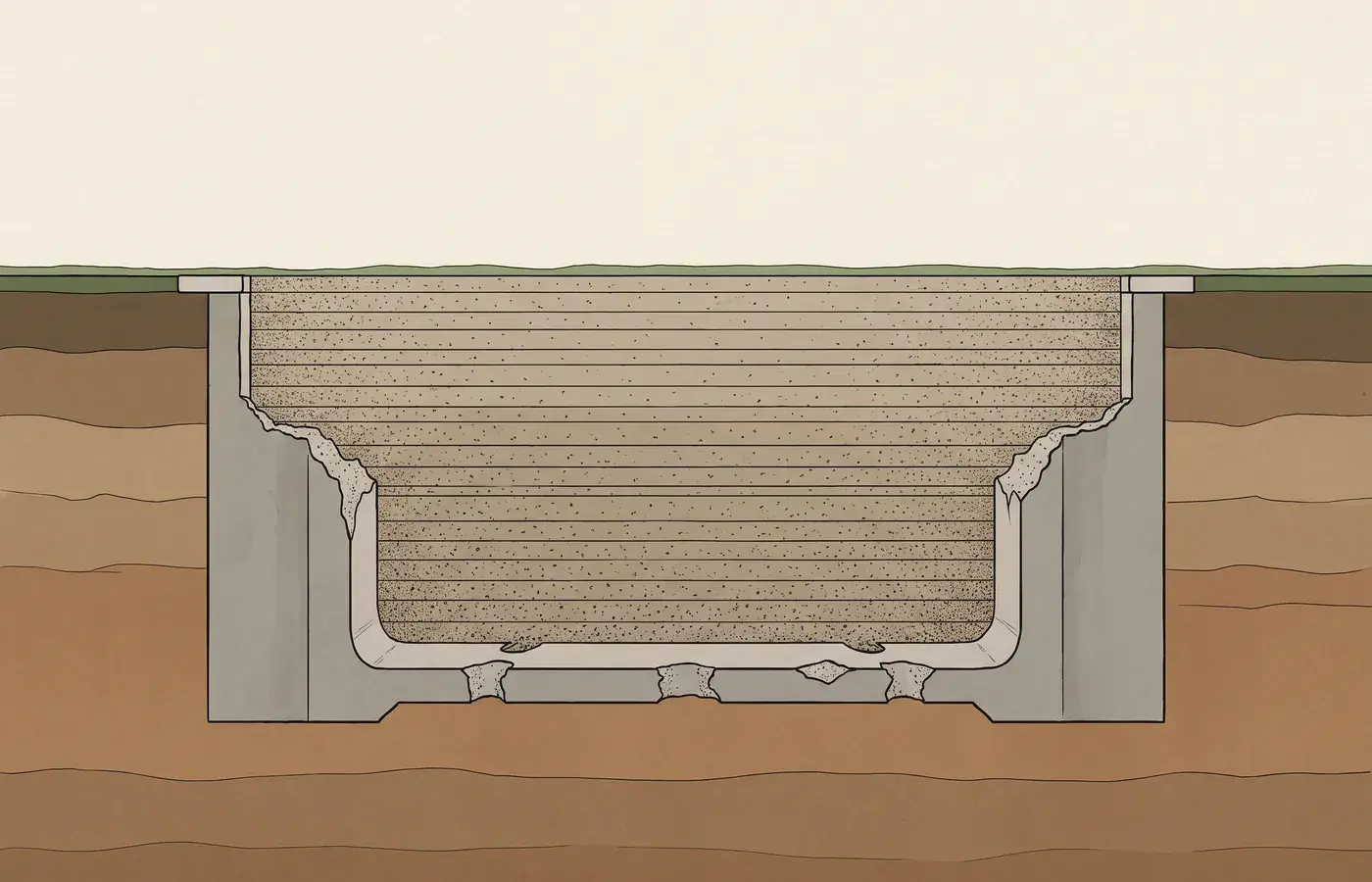
Plate 01—Partial fill-in
How does partial pool removal work in Granite Bay?
In short
Partial removal in Granite Bay takes out the upper shell, cuts drainage openings through what stays, then places and compacts approved fill. It is permitted by Placer County and is generally intended for open-yard uses where no structure is planned.
On a Granite Bay lot, the oak on the way to the pool matters more than the pool itself.
The Work
What happens during partial pool removal in Granite Bay?
- 1Upper shell comes out. Walls and bond beam broken out and hauled off.
- 2Drainage openings are cut. Through the remaining base, so water passes rather than collecting.
- 3Fill goes in, in lifts. Placed in layers and compacted as it goes.
- 4Rough grade. Shaped to drain away from structures.
Where the material goes from Granite Bay
On a larger Granite Bay parcel, the haul route from pool to street often covers more ground than it would on a smaller in-town lot, and a protected oak along that path means routing around its root zone rather than through it. Once material is off site, disposal follows Placer County Air Pollution Control District rules — gunite, rebar, plaster, and tile as construction and demolition debris — with CALGreen’s statewide 65% diversion baseline applying to concrete and metal recycling.
Local Requirements
How Granite Bay treats it.
Placer County publishes no handout specific to swimming pool demolition, so a partial pool removal here is permitted as a demolition and the scope is set by what the building official asks for on your property. That is normal — it just means the site walk carries more weight than a printed checklist would.
We prepare and coordinate the paperwork with Placer County. What we cannot do is promise how a department will rule on a specific property, and we will not tell you a permit is guaranteed.
Also applies here
Native oak protection
Unincorporated Placer County protects native oaks, and work inside a protected tree's root zone can bring an arborist into the conversation. On a pool removal this almost never touches the pool itself — it touches the route the excavator takes to reach it and where trucks and spoil get staged.
Source: Placer County, Tree Preservation / Native Oak protections (opens in a new tab)Verified August 22, 2026. Permit requirements change — confirm with the department before relying on this for your property.
Demolition debris diversion
California's CALGreen standards set a statewide baseline of 65% diversion for non-hazardous construction and demolition debris, and local jurisdictions can go further. In practice this is our paperwork rather than yours — broken concrete from a pool shell is one of the more recyclable things that leaves a residential property.
Source: CalRecycle, Construction & Demolition model ordinance guidance (opens in a new tab)Verified August 22, 2026. Permit requirements change — confirm with the department before relying on this for your property.
Fit Check
Partial fill-in in Granite Bay
- Permit authority
- Placer County Community Development Resource Agency, Building Services Division
- Generally fits
- Open-yard uses: lawn, planting, play space.
- Properties where equipment access is tight or expensive.
- Owners who want the pool gone without the fuller scope.
- Think twice if
- You may build a structure over the footprint later.
- You expect the area to carry heavy loads.
- You are selling soon — buried concrete is a known condition, and buyers ask.
- Ground
- Sierra foothill — Placer County
Source: Placer County Community Development Resource Agency, Building Permits (opens in a new tab)Verified August 22, 2026. Permit requirements change — confirm with the department before relying on this for your property.
Next step
Book a site walk in Granite Bay.
Whether a fill-in clears in Granite Bay depends on what the ground has to carry afterwards. Send the address and we will confirm it against the department that serves the property.
Getting In And Out
Access, ground and material movement.
Access in Granite Bay
Granite Bay’s larger parcels and foothill terrain make access planning a bigger part of the project than the permit itself. Placer County protects native oaks, and on a pool removal that protection almost never affects the pool work directly — it affects the equipment access route and where trucks and spoil get staged, since working inside a protected tree’s root zone can bring an arborist into the plan. Combined with the shallower soils and weathered granite typical of this part of the foothills, that means the practical path from street to pool — not just the permit application — is often the thing that determines how a Granite Bay project actually gets scheduled and staged.
Sierra foothill ground
This is Sierra Nevada foothill ground — shallower soils over weathered granite, and slopes that rarely give you a flat place to stage. Two consequences for a pool removal: rock can change the equipment and the schedule once you are below the shell, and grading has to be designed for a lot that already sheds water somewhere, so the finished surface drains the way the lot always did rather than sending it at a structure. Conditions vary parcel to parcel.
A fill-in moves less material than a full removal, which is exactly why it is often the option that makes sense on a tight lot. It does not make the drainage step optional.
Next Door
Nearby areas we cover.
Jurisdiction lines around Granite Bay do not follow the way the area actually reads on the ground. If your property sits near one of these, it is worth confirming which department your address falls under before anyone files anything.
- Partial fill-in in Roseville
Permits through the City of Roseville.
- Partial fill-in in Rocklin
Permits through the City of Rocklin.
- Partial fill-in in Folsom
Permits through the City of Folsom.
- Partial fill-in in Orangevale
Unincorporated — permits through Sacramento County.
Keep Reading
Where to go next.
Pool removal in Granite Bay
The full local picture — jurisdiction, overlays and the questions people in Granite Bay actually ask.
Full removal in Granite Bay
The other method, treated the same way. Worth reading both before deciding.
How partial pool removal works
The method in full detail, without the local layer.
What it costs
The conditions that move the number on a job like this.
Permits by jurisdiction
Every department we work with, and what each one publishes.
Backfill and compaction
Why the fill step is the one that decides how the ground behaves later.
Get On The Schedule
Get a partial fill-in estimate.
The form is already set to Granite Bay and to partial fill-in — change either if we have guessed wrong. Plenty of people research one method and end up choosing the other once they have seen the yard measured.
No obligation, no pressure
Request a site estimate.
Start with the property and what you want the ground to do afterwards. We will follow up to arrange the site walk and confirm the scope.