Resource
Ask these before you sign — they separate a real scope from a number on a card.
A pool removal quote is only as good as what’s actually in it. These are the questions that get a contractor talking specifics instead of generalities — and this list works just as well on us as it does on anyone else you’re considering.
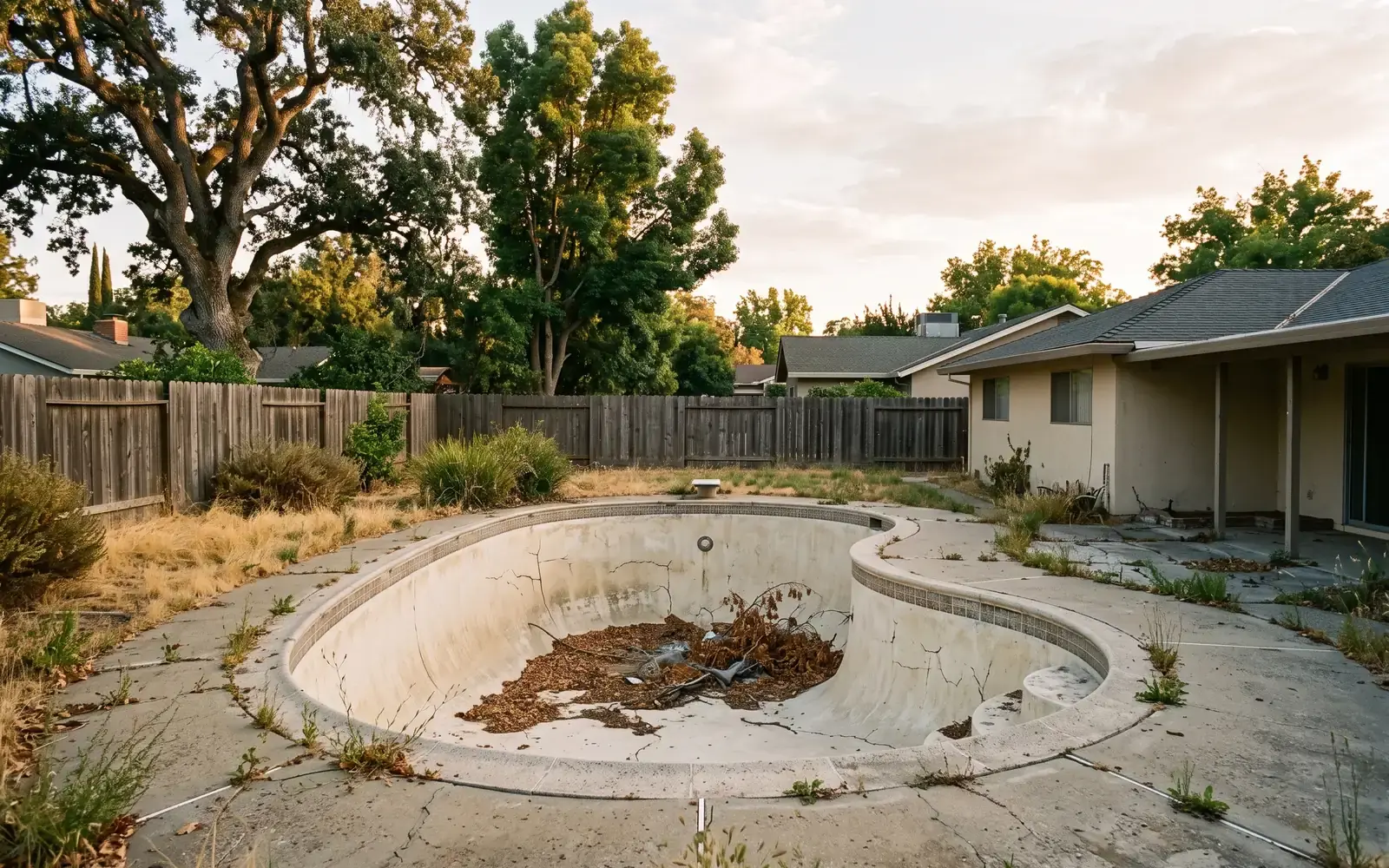
Plate 01—Before
What should you ask a pool removal contractor?
Short answer
The questions that matter cover licensing, who pulls the permit, exactly what’s being removed, how drainage and fill are handled, where debris goes, what the finished grade looks like, what’s written down versus assumed, the payment schedule, and what happens if something unexpected turns up. A contractor who answers all of these specifically, unprompted, is worth hiring. One who can’t is a risk you’re taking on blind.
A contractor who can’t name your permitting department by name hasn’t actually looked at your address yet.
Are you licensed, and what’s the number?
In California, pool removal demolition falls under CSLB classification C-21. Business and Professions Code section 7030.5 requires a licensed contractor’s number to appear in all advertising, so a legitimate company should give you theirs without being asked twice.
A good answer states the number plainly and doesn’t flinch if you say you’re going to look it up. A bad answer is vague — 'we’re licensed, don’t worry about it’ — or a number that doesn’t check out at cslb.ca.gov. Look the number up yourself before you sign anything; it takes under a minute and it’s the single most useful minute you’ll spend on this decision.
Who pulls the permit, and with which department?
Pool removal permits are handled by your specific city or county building department, and every jurisdiction runs the process a little differently. A contractor who has actually reviewed your address should be able to name the department without hesitating.
That specificity is the tell. 'We handle all the permits’ is not an answer — it’s a placeholder for one. Ask which office, and whether the permit is pulled in the contractor’s name or yours; both are normal, but you should know which.
Is this partial or full, and exactly how much shell is coming out?
Partial fill-in leaves the lower portion of the shell in the ground with drainage openings cut through it. Full removal takes the entire shell out. These are different jobs with different equipment needs and different implications if you ever want to build on that footprint.
A good answer describes which one fits your stated plans for the space and explains why. A bad answer treats the two as interchangeable, or picks one without asking what you intend to do with the yard afterward.
How are drainage openings handled on a fill-in?
If the lower shell stays in the ground, water needs somewhere to go — openings are cut through the remaining concrete so groundwater doesn’t collect in what’s effectively a buried bowl. This is a basic, well-understood step, not an extra.
A good answer explains where and how the openings are cut. A bad answer doesn’t mention drainage at all, which is a sign the fill-in isn’t being planned properly rather than just described poorly.
Worth Knowing
What fill material, and how is it compacted?
Backfill should be an approved material placed and compacted in layers, called lifts, rather than dumped in all at once. Compaction is what prevents settlement later — loose fill settles under its own weight and under the weight of anything built or planted on top of it.
A good answer names the fill material and describes compacting in lifts, unprompted. A bad answer is 'we’ll fill it in and grade it,' with no mention of compaction — that’s the sentence that ends up costing a homeowner a sunken patch a season or two later.
Next step
Ready to find out what your property needs?
A site walk is where an accurate scope starts — access, shell type, depth, utilities and what you want the ground to do afterwards.
At A Glance
What a good answer sounds like — and what should worry you
| Criterion | Good answer | Bad answer |
|---|---|---|
| License number | Gives you the number unprompted, and it checks out at cslb.ca.gov | Says 'don’t worry about that’ or gives a number that doesn’t check out |
| Who pulls the permit | Names the specific department for your address | Says 'we’ll handle it’ with no department named |
| Down payment | Asks for the lesser of $1,000 or 10% of the contract price | Asks for half up front, or the full amount |
| Unexpected conditions | Describes how changes get documented and priced before work continues | Says 'we’ll figure it out’ with nothing in writing |
| Drainage on a fill-in | Explains where openings are cut and why | Doesn’t mention drainage openings at all |
| Hauled material | Offers a destination and documentation without being asked twice | Has no answer for where the material goes |
Source: California Contractors State License Board, Licensing Classifications — C-21 Building Moving/Demolition (opens in a new tab)California Legislative Information, Business & Professions Code § 7030.5 — Licence number in advertising (opens in a new tab)California Contractors State License Board, Home Improvement Contracts — What Is A Contract (opens in a new tab)Verified August 22, 2026. Permit requirements change — confirm with the department before relying on this for your property.
Where does the material go, and what documentation do I get?
Demolished shell material and excavation spoils have to be hauled somewhere, and where matters. Ask directly, and ask what proof you get — a receipt, a manifest, anything that shows the material was disposed of properly rather than just driven off the property.
A good answer names a destination and offers documentation without you having to push for it. A bad answer is 'we take care of it,' full stop.
What does the finished grade look like, and does it drain away from the house?
The whole point of backfilling and grading is a usable, stable surface — and the direction water moves across that surface after a rainstorm matters more than almost anything else about the finished product. Grade that pitches toward the house instead of away from it is a problem you won’t see until the next wet season.
A good answer describes the intended slope and how it ties into your existing drainage. A bad answer doesn’t mention drainage direction at all, treating grading as just 'making it flat.'
What’s in writing, and what’s assumed?
Everything that matters should be in the contract: partial or full, fill material, compaction method, hauling and documentation, finished grade, what’s included, and what’s explicitly not — fence repair, sprinkler capping, sod, permit fees. If it’s not written down, it’s an assumption, and assumptions are where disputes come from.
A good contractor walks you through the written scope line by line and tells you plainly what you’re left with when they’re done, and what you’ll still need to arrange yourself. A bad one hands you a one-page estimate with a price and a handshake.
What’s the payment schedule?
California law caps the down payment on a home improvement contract at whichever is less: $1,000 or 10% of the contract price, not counting any finance charges. This is a state protection, not a negotiable term, and it exists specifically because home improvement work is a common place for homeowners to get burned upfront.
A good contractor states this cap as a matter of course. A bad one asks for half down, or the full amount before work starts — either one is a legal red flag, not just an aggressive term.
What happens if you hit something unexpected?
Old pools sometimes come with surprises: undocumented plumbing, a shell that’s deeper or thicker than expected, soil that doesn’t compact the way it should. None of that is unusual, and a contractor who’s done this before has a process for it.
A good answer describes how a change gets documented and priced before work continues — a change order, a phone call, something you can point to later. A bad answer is 'we’ll figure it out,' which usually means figuring it out on your final invoice.
Next step
Ready to put a number on your property?
Every answer above changes with access, shell type, depth and what you want the ground to do afterwards. The site walk is what settles them.
Questions On File
Common questions.
Yes. A single bid gives you one contractor’s read on your property and nothing to compare it against. Getting two or three lets you see whether they agree on scope — partial versus full, what fill and compaction they’re proposing, what’s included — because a wide gap in scope explains a wide gap in price far more often than one contractor simply being better than another.
Start With The Site
Bring this list to our site walk.
Genuinely. If we cannot answer these in front of you, standing in your yard, that tells you something worth knowing before you sign anything.
Send the basics
Four required answers. Add detail only if it helps.
Walk the property
We confirm access and the scope on site.
Get it in writing
Recommended option, sequence and what happens next.
Still researching the work? Read the complete pool removal service overview.
No obligation, no pressure
Request a site estimate.
Start with the property and what you want the ground to do afterwards. We will follow up to arrange the site walk and confirm the scope.
Read Next
Related reading.
Permits by jurisdiction
So you already know which department the answer should name.
What pool removal costs
The drivers behind any number you are quoted.
Backfill and compaction
Background for the fill questions, which are the ones most often waved away.
Partial or full removal
Know which one you are being quoted before you compare two prices.
How long it takes
How to tell a real schedule from a comfortable one.
About the Guys
Our own answers to several of these, in public.