Building On It Later
Pool removal for an ADU, addition, or shop build.
You want to put an ADU, an addition, a garage, or a shop where your pool sits now. The pool has to come out first, and the way it comes out determines whether a structure can legally sit there afterward. Here’s how that decision actually gets made.
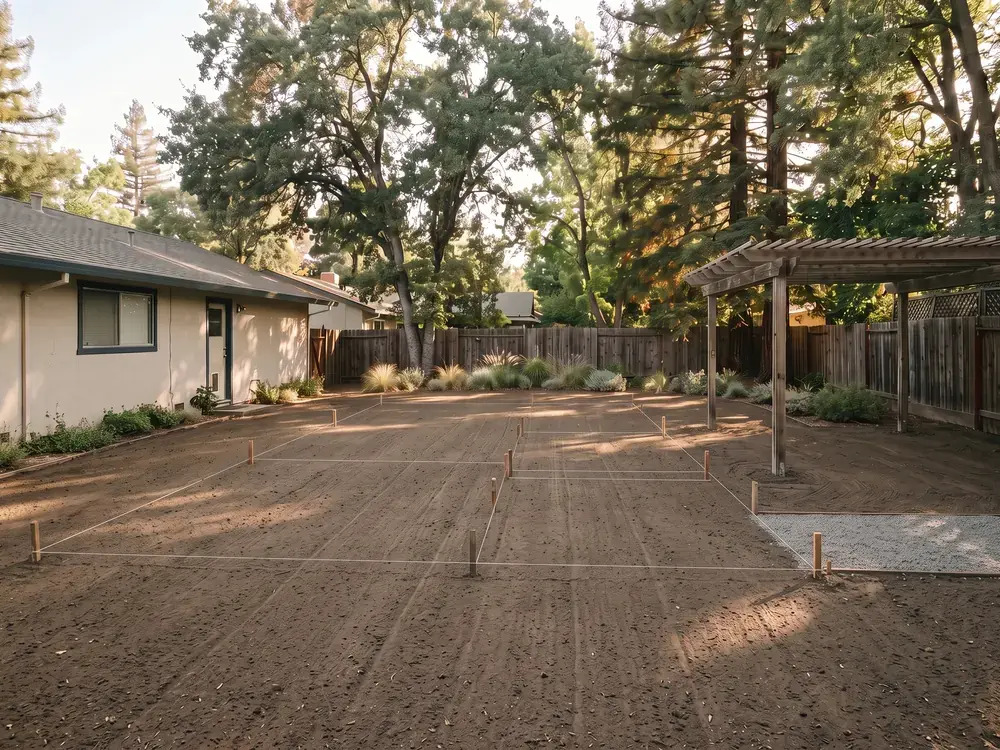
Plate 01—Future Build
Can you build an ADU or addition over a filled-in pool?
Short answer
California’s statewide ADU law does not address building over a former swimming pool or over pool fill — it is silent on the question. Whether a local building department approves an ADU, addition, or garage on that footprint is decided case by case under general foundation and soils rules, based on the quality of the fill, how it was compacted, and what a soils report finds.
We’ve seen filled pools pass a soils report without issue, and ones that need re-excavation. The fill decides it, not the calendar.
Does California’s ADU law say anything about building over a pool?
No. Search the state ADU statute (Government Code section 66310 and following) or HCD’s ADU Handbook and you will not find the words "pool," "fill," or "former pool footprint." The law tells cities and counties how fast to process an ADU application, what setbacks they can and can’t require, and when they have to allow one by right. It says nothing about what’s allowed to be under the slab.
That silence isn’t an oversight, and it doesn’t mean the state has cleared the way. It means the state left this specific question exactly where it already lived: with the local building department, under the general rules that apply to any foundation — the California Building Code’s chapter on soils and foundations (Chapter 18). That’s the chapter governing whether the ground under any structure, pool-related or not, is fit to build on.
Most information online glosses over this and implies state ADU law either makes building over a pool easy, or flatly forbids it. Neither is accurate. The honest answer is less satisfying and more useful — nobody in Sacramento can tell you yes or no until your specific site, fill, and plans are in front of a plan checker.
Why this question decides partial vs. full removal for you
If there’s any chance a structure goes on the former pool footprint — now or in five years — that possibility should drive which removal option you choose, not the other way around. Partial fill-in leaves the lower shell and base of the pool in the ground, with drainage openings broken through it and fill placed on top. Full removal takes the entire shell out and backfills the open excavation.
A building department evaluating a foundation wants to know what’s under it. Broken pool shell left in place under a partial fill-in is a harder thing to certify than a fully excavated, properly backfilled hole, because the old concrete creates uneven bearing and inconsistent settlement even when the fill above it is done right. Full removal doesn’t guarantee approval, but it removes an entire category of the argument.
This is the actual reason we tell people to make the pool-removal decision before the ADU design, not after. If you’re not sure whether you’ll ever build on that spot, full removal is the option that keeps it open.
What "engineered fill" means to a building department
Engineered fill is fill that was placed, compacted in measured lifts, and tested as it went in — with records to prove it. It’s a process, not a material. The opposite is fill that was pushed into a hole and graded over, with no compaction testing and no paperwork, which is what a lot of older backyard pool fill-ins actually are.
A soils engineer or building department isn’t asking whether dirt is in the hole. They’re asking whether it produces predictable, uniform bearing capacity, because unpredictable settlement under a slab is what cracks foundations and shows up as expensive damage years later. That’s a call the geotechnical engineer and the local department make on your specific soil — we won’t state a compaction percentage or testing standard here as if it were a fixed statewide number, because it isn’t one.
What separates engineered fill from uncertified fill
- Placed and compacted in controlled lifts, not dumped in all at once
- Compaction tested as the work happens, with records kept
- Material suited to bearing a structure, not just filling a void
- A paper trail a soils engineer or building department can review later
Worth Knowing
Why a soils report enters the picture, and who asks for it
For a lot of standalone backyard ADUs on undisturbed native soil, plan check can move without a project-specific geotechnical report, depending on your jurisdiction’s standards and your design professional’s judgment. A former pool footprint changes that calculus. Disturbed, filled ground is exactly the condition soils reports exist to evaluate, and your architect, engineer, or the building department itself may require one before signing off on a foundation there.
The soils report isn’t paperwork for its own sake. It tells your design professional what kind of foundation the ground under your ADU actually needs — sometimes a standard slab, sometimes a more robust foundation system to bridge inconsistent fill. Skipping that step doesn’t avoid the requirement; it just moves the discovery to a more expensive point in the process.
We coordinate demolition and backfill. We are not soils engineers, and we won’t tell you a report will pass — that call belongs to the geotechnical professional who writes it and the department that reviews it.
Next step
Ready to find out what your property needs?
A site walk is where an accurate scope starts — access, shell type, depth, utilities and what you want the ground to do afterwards.
At A Glance
Partial fill-in vs. full removal, for a future ADU or addition
| Criterion | Partial fill-in | Full removal |
|---|---|---|
| What stays in the ground | Lower pool shell and base, with drainage openings | Nothing — shell fully excavated and hauled off |
| Typical fit for a future structure | Generally not recommended if you may build here | Generally the option once construction is planned |
| Soils report likelihood | Depends on plans; open-yard use often doesn’t need one | More often requested, given the disturbed, backfilled ground |
| What a plan checker sees | Old concrete under new fill — harder to certify | A fully backfilled, compactable excavation |
| Best decided | Before you’ve ruled out ever building on the spot | As soon as an ADU, addition, or shop is even possible |
Source: California Department of Housing and Community Development, Accessory Dwelling Unit Handbook (opens in a new tab)Verified August 22, 2026. Permit requirements change — confirm with the department before relying on this for your property.
Why removing the pool before you design the ADU is usually the cheaper order
Homeowners who design the ADU first and hit the pool problem at plan check tend to pay twice: once for a design revised around a foundation condition nobody accounted for, and once for the removal and backfill that should have happened before the drawings existed.
Removing the pool first gives your architect or designer a known, documented condition to design against. If a soils report is needed, it can be pulled on finished, compacted fill rather than an open pool or a construction-in-progress site — generally what a geotechnical engineer wants to evaluate anyway. Sequencing removal first doesn’t guarantee a smoother plan check, but it removes one of the more common causes of a stalled one.
What if someone filled the pool in years ago and you don’t know how?
This comes up constantly. A previous owner filled the pool in, sold the house, and nobody involved in your purchase has a permit, a compaction record, or any idea what actually went into that hole. This is the hard case, and it’s a common one — not a rare edge case.
Undocumented fill isn’t automatically disqualifying, but it removes the shortcut. Without records, a soils engineer generally has to treat the ground as an unknown and test it directly, which sometimes means the fill needs to be probed, tested, or in some cases removed and redone before anyone can certify what’s under a future foundation. There’s no way to know which of those applies to your yard without someone actually looking at it.
If you’re in this position, say so up front — to us, to your designer, and to the building department. Guessing or hoping it was done right is the version of this that gets expensive.
Setbacks, access, and other site factors that affect the build
A former pool footprint that works from a soils standpoint still has to work from a zoning standpoint. ADU setback rules, lot coverage limits, and utility easements apply to that spot the same as anywhere else on your lot — and state ADU law does have specific things to say about setbacks. That part is genuinely addressed, unlike the fill question.
Access matters on the construction side too. How equipment gets into the yard to remove the pool, and later how a contractor gets material and equipment in to build the ADU, can shape both projects. Tell us about the intended structure at the site walk and we’ll flag anything about access or the footprint that’s relevant to it — we just can’t rule on zoning or setbacks; that’s your design professional’s and your planning department’s call.
What we can do, and what we won’t promise
We remove the pool, coordinate the demolition permit, and place and compact backfill to a finished grade — full removal when a structure may go on the footprint, partial when it won’t. We’ll tell you plainly what we see in your yard and what questions we think your soils engineer or building department will ask.
We won’t promise a soils report will pass, a building department will approve your ADU, or that any specific compaction standard applies to your project. Those are calls made by licensed design professionals and your local jurisdiction, not by a pool removal contractor. Anyone who tells you otherwise before they’ve seen your soil is guessing.
Next step
Ready to put a number on your property?
Every answer above changes with access, shell type, depth and what you want the ground to do afterwards. The site walk is what settles them.
Questions On File
Common questions.
State ADU law doesn’t say either way — Government Code section 66310 and HCD’s ADU Handbook don’t mention pools, fill, or former pool footprints at all. The question isn’t governed by ADU law; it’s governed by general foundation and soils rules under the California Building Code, and it’s decided locally by your building department based on your specific fill and site. Anyone claiming state law clears or blocks this outright is oversimplifying it.
Start With The Site
Planning to build on it?
Tell us that at the site walk and it changes the recommendation. Removing a pool for a future structure is a different scope from removing one for a lawn.
Send the basics
Four required answers. Add detail only if it helps.
Walk the property
We confirm access and the scope on site.
Get it in writing
Recommended option, sequence and what happens next.
Still researching the work? Read the complete pool removal service overview.
No obligation, no pressure
Request a site estimate.
Start with the property and what you want the ground to do afterwards. We will follow up to arrange the site walk and confirm the scope.
Read Next
Related reading.
How full removal works
Generally the option when a structure may go on the footprint later.
Backfill and compaction
The difference between fill that can carry a foundation and fill that cannot.
Partial or full removal
If you are building, this decision is largely made for you. Here is why.
Permits by jurisdiction
The department that decides your ADU foundation is the one in this directory.
Removing a pool before selling
The other reason people remove rather than repair, and it has different rules.
What pool removal costs
Removing for future construction changes the scope, and the scope drives the number.