Resource
How long pool removal takes depends on everything around the demolition, not the demolition itself.
Ask five contractors how long pool removal takes and you’ll get five different numbers, none of them reliable. The honest answer is that demolition is usually the shortest stage. Permitting, utility notification, access and weather are what actually stretch or compress a project.
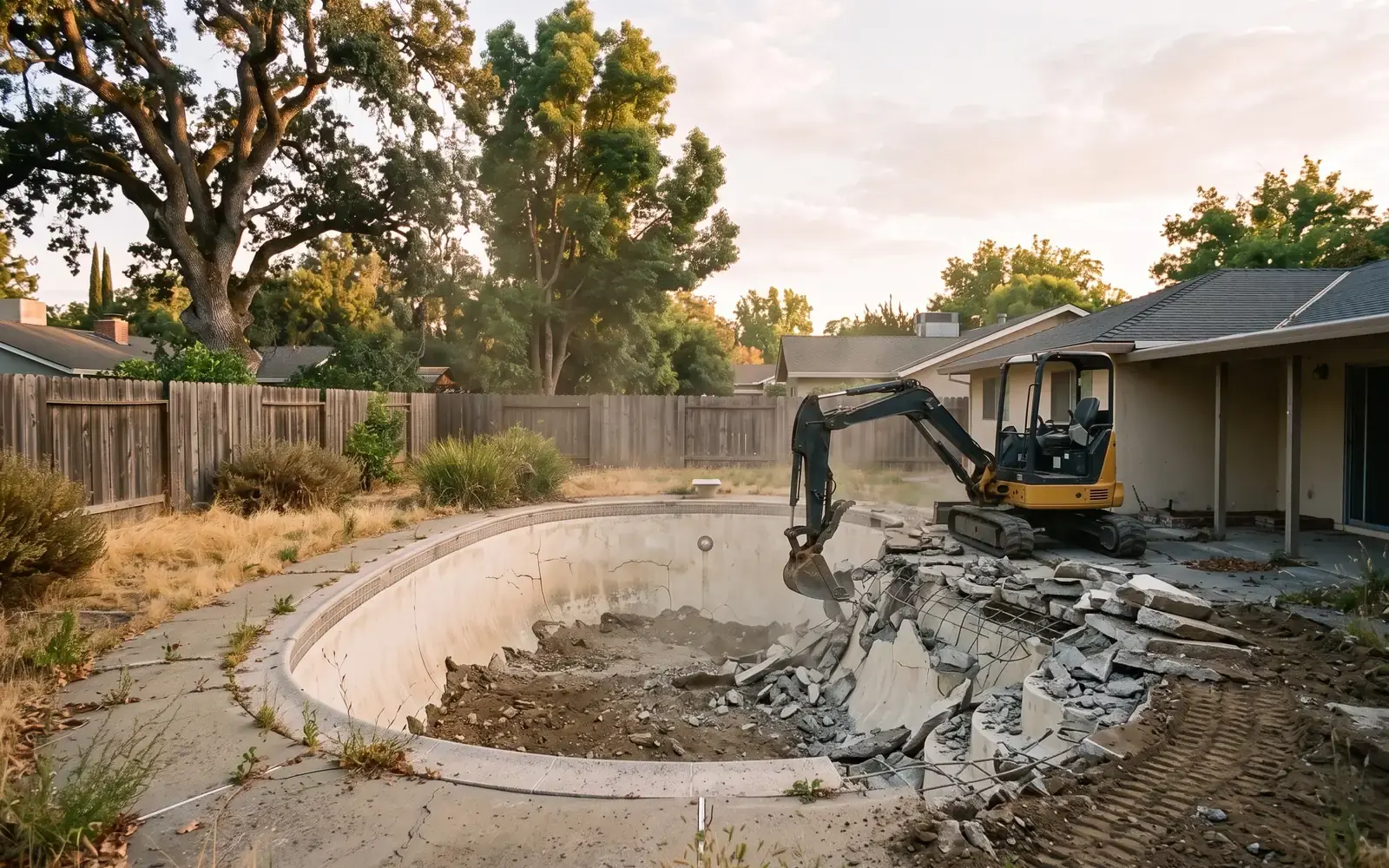
Plate 02—Removal
How long does pool removal take?
Short answer
There’s no dependable duration to quote, because permit review varies by jurisdiction and season, utility notification has a legal minimum but no maximum, and site conditions — access, water in the pool, fill needs, weather — differ on every property. What’s consistent: the physical demolition is typically the shortest stage. Permitting and site prep are what actually set your calendar, not the excavator.
Every yard we’ve walked has a different gate width, a different permit desk and a different water table. None of it repeats.
Why we won’t give you a number
Every pool removal company gets asked how long the job takes, and most give an answer anyway — a range that means nothing once your permit lands with a backlogged reviewer, or your yard turns out to have a gate too narrow for standard equipment. We’d rather explain what governs your schedule than hand you a number we can’t stand behind.
That’s not a dodge. Permit turnaround differs by jurisdiction and by season. Utility notification has a legal minimum wait but no ceiling. Sacramento weather can push a project into a wet-season delay that has nothing to do with us or with you. A contractor who quotes a firm number before the site walk is quoting a guess.
The sequence, stage by stage
A pool removal project moves through the same stages regardless of address. What changes is how long each one takes, and sometimes whether it happens at all.
- 1Site walk and a written scope of work
- 2Permit application and review
- 3Utility notification (811)
- 4Water discharge, if the pool holds water
- 5Access preparation
- 6Demolition
- 7Hauling
- 8Fill delivery and placement
- 9Grading
- 10Final inspection
The site walk and getting a scope in writing
Before anything else, someone has to look at your yard: access, slope, utilities, whether the pool still holds water, and what you want the space to become. That last part matters more than it sounds — a scope written for open lawn looks different from one written for a future structure, and the wrong assumption here costs time later when it has to be corrected.
A written scope is also what a permit application is built from. If a contractor skips straight to a number without walking the property, that number was never tied to your actual conditions.
Permit application and review
This is usually the least predictable stage, because it depends on the jurisdiction, not on us. Some cities and counties in our service area process permits entirely through an online portal. Others require an inspector to sign off on the site before demolition can start. Some require an approved waste management plan before the demolition permit is even issued — a separate document, on a separate track, that has to clear first.
Review volume shifts with the season, too. A department that moves quickly in the off-season can slow when pool season pushes removal and outdoor-construction permits through the same office at once. None of this is something a contractor controls, and anyone who tells you otherwise hasn’t dealt with your specific department.
Worth Knowing
Utility notification and the 811 rule
This is one of the few parts of the timeline with an actual legal figure attached. California Government Code section 4216 requires notification to the regional utility notification center (811) before excavation, and excavation may not begin until at least two working days after that notification — not counting the day it was made.
That two-day minimum is a floor, not a target. Utilities have that window to mark their lines; if a location is unclear or more time is needed, the wait can run longer. It can’t be skipped or shortened by agreement — it’s a safety statute, not a scheduling courtesy.
Next step
Ready to find out what your property needs?
A site walk is where an accurate scope starts — access, shell type, depth, utilities and what you want the ground to do afterwards.
At A Glance
Stage by stage — what actually governs how long it takes
| Stage | What governs its length |
|---|---|
| Site walk & written scope | Scheduling and property complexity |
| Permit application & review | Jurisdiction, season, and whether a waste management plan must clear first |
| Utility notification (811) | Minimum 2 working days by law; can run longer if lines are unclear |
| Water discharge | Local discharge rules and proximity to storm drains or waterways |
| Access preparation | Whether fencing, gates or walls need to come out for equipment |
| Demolition | Shell size and type — generally the fastest stage |
| Hauling | Volume of debris and site room for trucks or a container |
| Fill delivery & placement | Volume of fill and lift-by-lift compaction |
| Grading | Final surface shape and drainage requirements |
| Final inspection | Department scheduling, separate from the physical work |
Source: California Legislative Information, Government Code § 4216 — Protection of Underground Infrastructure (opens in a new tab)City of Folsom Community Development, Building Services Division (opens in a new tab)City of Lincoln, Building Permits — Community Development Permit Center (opens in a new tab)Verified August 22, 2026. Permit requirements change — confirm with the department before relying on this for your property.
Water discharge and access preparation
If the pool still holds water, it has to come out before demolition, and how it comes out is regulated — where it can be discharged depends on local rules that a straightforward yard may clear in one step and a yard near a storm drain or waterway may not.
Access preparation is the other variable that’s easy to underestimate. If equipment can’t reach the pool without removing a fence panel, a gate, or a section of block wall, that removal and its later repair are their own line items with their own timing. A pool behind a narrow side gate is a different job than one with a driveway straight to the backyard, even if the pool itself is identical.
Demolition and hauling
This is the stage most people picture, and it’s genuinely the fastest part of the sequence once it starts. Breaking out the shell — partial or full — and loading debris for haul-off is mechanical work with a predictable pace, assuming access and utility clearance are already handled.
What can still slow it down: how much material there is to move, how many truck trips hauling requires, and whether the property allows a container to stage on-site versus needing a remote drop point.
Fill, grading and final inspection
Backfill isn’t dumped in and leveled — it’s placed and compacted in lifts, layer by layer, with each layer compacted before the next goes in. That takes as long as the volume of fill requires, and it’s not worth rushing, since inadequately compacted fill is the most common cause of settlement later.
Rough and final grading follow, shaping the surface so water sheds away from the house rather than pooling in the old footprint. Many jurisdictions require a final inspection before the permit closes out, and scheduling that depends on the department’s calendar, not on how fast the physical work went.
Weather, and what you can actually control
Sacramento’s dry season makes most of the year workable, but a wet fall or winter reorders a schedule. Saturated soil can’t be properly compacted, standing water in an open excavation is a safety problem, and heavy rain can delay hauling if a site turns to mud. None of that is a contractor stalling — it’s the ground telling you it isn’t ready.
What you can control: how fast you respond to requests, how quickly you make scope decisions, and whether the yard is cleared before the crew is scheduled. What you can’t control: permit review speed, utility response time, or weather. A contractor who promises to 'expedite’ a permit application is either overstating their influence or describing a jurisdiction that genuinely moves fast — a fact about the jurisdiction, not a company skill.
Next step
Ready to put a number on your property?
Every answer above changes with access, shell type, depth and what you want the ground to do afterwards. The site walk is what settles them.
Questions On File
Common questions.
Money can sometimes buy faster hauling capacity or a bigger crew on demolition day, but it doesn’t buy faster permit review — that’s set by the department processing your application, not by your contractor’s budget. The stages most people want sped up (permitting, utility notification, inspections) are the ones least responsive to schedule pressure. Extra resources genuinely help with the physical work: demolition, hauling and fill placement can move faster with more equipment on-site, assuming access allows it.
Start With The Site
Need it done by a particular date?
Say so early. Some of the sequence can be compressed and some of it genuinely cannot, and knowing which is which before you commit to a date is the whole game.
Send the basics
Four required answers. Add detail only if it helps.
Walk the property
We confirm access and the scope on site.
Get it in writing
Recommended option, sequence and what happens next.
Still researching the work? Read the complete pool removal service overview.
No obligation, no pressure
Request a site estimate.
Start with the property and what you want the ground to do afterwards. We will follow up to arrange the site walk and confirm the scope.
Read Next
Related reading.
How a removal runs
The same sequence, from our side of it.
Permits by jurisdiction
The stage with the most variance, and it varies by department.
Questions to ask a contractor
Including the ones that reveal whether a promised schedule is real.
What pool removal costs
Many of the things that stretch a schedule also move the number.
What to do after removal
The part that starts once the crew leaves, and runs longer than the job did.
Partial or full removal
Scope drives duration more than anything else on this list.