Placer County · Valley terrace
Pool removal in Roseville, CA.
Roseville sits on the valley terrace side of Placer County, and most pool removal projects here look like standard suburban demolition work: a shell to break up, a hole to backfill or grade, and a permit application that has to clear the City of Roseville Development Services, Building Division before anyone can dig.
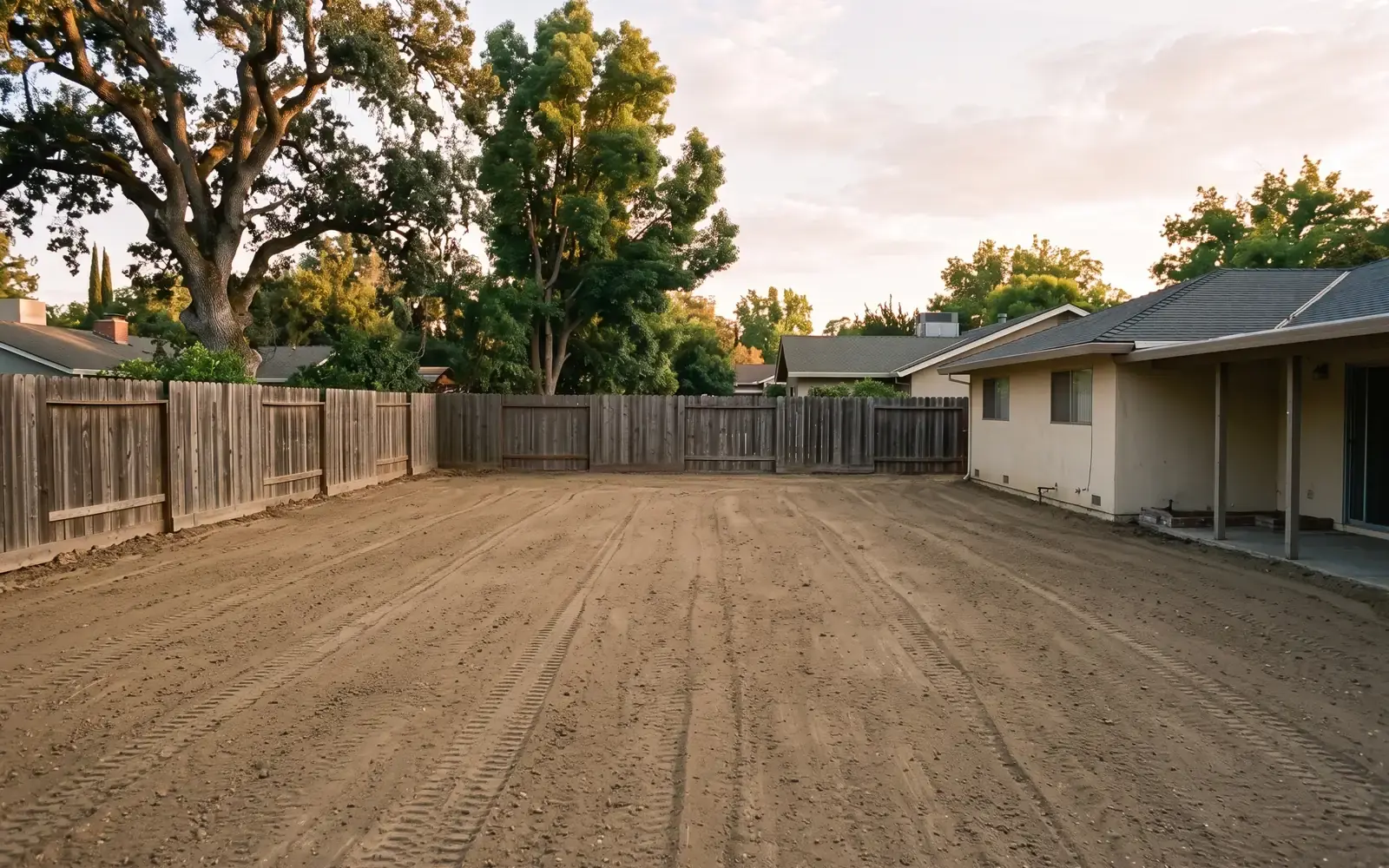
Plate 01—Final Grade
Do you need a permit to remove a pool in Roseville, CA?
Short answer
The City of Roseville Development Services, Building Division issues pool removal permits here, and there’s one paperwork item worth knowing about going in: an Asbestos NESHAPS Declaration of Notification Compliance form has to be filed with the demolition permit application. That local requirement still applies even though most single-family homes are exempt from the federal asbestos notification rule itself.
The city does not publish a pool-specific demolition handout, so the permit process follows the same demolition track used for any other structure on the lot. One piece of paperwork trips people up more than anything else: the Asbestos NESHAPS Declaration of Notification Compliance form. It has to be filed with the demolition permit application regardless of the size of the job. Homeowners sometimes hear that single-family residences of four units or fewer are excluded from the federal asbestos notification rule and assume that means no paperwork at all — that federal exclusion does not cancel Roseville’s own form. The city still wants it filed before the permit moves forward.
Jurisdiction
Who issues a pool demolition permit in Roseville, CA?
Roseville is an incorporated city with its own building department. A pool demolition inside city limits is permitted by City of Roseville Development Services, Building Division, not by Placer County.
Worth confirming rather than assuming: a mailing address is not the same thing as a jurisdiction, and unincorporated county ground in this region frequently sits directly against a city line.
the City of Roseville does not publish a handout specific to swimming pool demolition. That is not a problem with your project — it means the scope is set against the general demolition permit and what the building official asks for on your lot, rather than against a printed checklist. Two jurisdictions in our service area do publish one, and we say which on the permits page.
That asbestos form isn’t optional paperwork you can skip because your house is exempt federally — Roseville still wants it filed.
On File
Roseville at a glance
- Permit authority
- City of Roseville Development Services, Building Division
- Jurisdiction type
- Incorporated city in Placer County
- County
- Placer County
- Permit counter
- 916-774-5332
- Air district
- Placer County Air Pollution Control District
- Pool-specific guidance
- None published — general demolition permit applies
- Ground
- Valley terrace
Source: City of Roseville Development Services, Building Permits (opens in a new tab)Placer County Air Pollution Control District, Asbestos in Building Materials (opens in a new tab)Verified August 22, 2026. Permit requirements change — confirm with the department before relying on this for your property.
Local Overlays
What else applies here.
A demolition permit is rarely the only rule touching a backyard project. These are the ones published for Roseville that genuinely affect how a pool removal runs.
Asbestos declaration with the demolition permit
Roseville requires an Asbestos NESHAPS Declaration of Notification Compliance form as part of a demolition permit application. Worth separating from the federal rule: single-family residences of four units or fewer are excluded from federal asbestos NESHAP notification, but that exclusion does not remove a city's own paperwork requirement. Two different things, and the local form is the one that holds up a permit.
Source: City of Roseville Development Services, Building Permits (opens in a new tab)Verified August 22, 2026. Permit requirements change — confirm with the department before relying on this for your property.
Demolition debris diversion
California's CALGreen standards set a statewide baseline of 65% diversion for non-hazardous construction and demolition debris, and local jurisdictions can go further. In practice this is our paperwork rather than yours — broken concrete from a pool shell is one of the more recyclable things that leaves a residential property.
Source: CalRecycle, Construction & Demolition model ordinance guidance (opens in a new tab)Verified August 22, 2026. Permit requirements change — confirm with the department before relying on this for your property.
Site Conditions
The ground, the gate and the truck.
Valley terrace ground
This sits on the older terrace ground between the valley floor and the foothills, where soils are generally denser and can carry cemented hardpan layers. Hardpan cuts both ways on a pool removal: it can make for a firm, stable base under compacted fill, and it can also mean an excavator that is fine for eight feet suddenly is not. Actual conditions vary lot to lot and are settled at the site walk, not on a map.
Access and equipment
Side-yard gates, existing hardscape, mature landscaping, and HOA-governed setbacks vary block to block in Roseville, so equipment access still gets confirmed on site rather than assumed from an address, even though the valley terrace ground here is generally more forgiving than the sloped foothill lots to the east. A standard excavator can typically reach the pool without the staging workarounds a hillside lot requires. Fencing, pool equipment pads, and any structures built close to the pool edge over the years can also narrow the path equipment needs to travel, and that gets sorted out during a site walk, not guessed at over the phone.
Hauling and disposal
Once the shell breaks up, the material — gunite or shotcrete, rebar, plaster, tile — has to be hauled off and disposed of as construction and demolition debris under Placer County Air Pollution Control District rules, not the Sacramento district next door. California’s statewide CALGreen code sets a 65% diversion baseline for that category of debris, so concrete and metal recycling is generally the default plan rather than an extra step. Utility locates go through 811 before any excavation starts, with a mandatory two-working-day wait after notification required under state law.
Next step
Get a site walk booked in Roseville.
Send the address and the basics. We confirm the department that serves the property, walk the site, and put the scope in writing before anything moves.
Two Ways To Do It
Partial fill-in or full removal.
The mechanics are the same everywhere. What changes in Roseville is the department reviewing it and what they want to see — which is why this decision is worth making before anyone files anything.
| Criterion | Partial fill-in | Full removal |
|---|---|---|
| What comes out | The upper portion of the shell — typically the walls and bond beam. | The entire shell, hauled off the property. |
| Drainage | Openings are cut through the remaining base so water passes rather than collecting. | No shell remains, so there is no bowl to drain. |
| Fill | Approved fill placed and compacted in lifts over the remaining base. | The open excavation backfilled and compacted in lifts. |
| Future structures | Generally not intended to carry a structure. Concrete stays in the ground. | Generally the option when a structure may go on the footprint later. |
| Disclosure on sale | Buried concrete is a known condition a seller generally discloses. | Fewer questions, because nothing was left behind. |
| Access and cost pressure | Less material to move, so tight access hurts less. | More material out and more fill in, so access matters more. |
How the project runs
Five stages. One written plan.
- 1
Plan
Walk the site, confirm the removal goal, access and visible constraints.
- 2
Permit
Prepare and coordinate paperwork with the department serving the property.
- 3
Remove
Demolish the shell to the approved scope and haul debris away.
- 4
Backfill & Compact
Place approved fill in lifts according to the project requirements.
- 5
Grade & Document
Finish the surface to the agreed grade and close out available project records.
Asked In Roseville
Pool removal in Roseville — common questions.
Pool removal in Roseville falls under the City’s standard demolition permit process, handled by Development Services, Building Division. There’s no separate 'pool removal’ permit type — it’s the same demolition track used for removing any other structure, with the addition of the Asbestos NESHAPS Declaration of Notification Compliance form that has to be filed with the application.
Next Door
Nearby areas we cover.
Jurisdiction lines around Roseville do not follow the way the area actually reads on the ground. If your property sits near one of these, it is worth confirming which department your address falls under before anyone files anything.
- Pool removal in Rocklin
Permits through the City of Rocklin.
- Pool removal in Granite Bay
Unincorporated — permits through Placer County.
- Pool removal in Citrus Heights
Permits through the City of Citrus Heights.
- Pool removal in Antelope
Unincorporated — permits through Sacramento County.
- Pool removal in Lincoln
Permits through the City of Lincoln.
- Pool removal in Loomis
Permits through the Town of Loomis.
Next step
Still deciding what to do with the Roseville backyard?
Send the address and the basics. The site walk confirms access, shell type and what the department serving the property needs to see.
Read Next
Before you decide.
What pool removal costs
The conditions that move the number, and why nobody quotes one from a map.
Permits by jurisdiction
How the City of Roseville compares to the other departments in the region.
Backfill, compaction and grading
The half of the job that decides whether the ground behaves in five years.
Compare partial and full removal
The full side-by-side, including what each does to your options later.
How a removal runs
Site walk, plan, permits, demolition, backfill and grade — in order.
Removing a pool to build
What an ADU or addition over the old footprint actually requires.
Fiberglass
A one-piece shell that comes out differently — and often more cleanly — than concrete.
Get On The Schedule
Start with a site walk in Roseville.
We look at access, utilities, slope, depth and what is actually in the ground, then tell you which option fits what you are planning and put the scope in writing. No number gets quoted from a map.
If your property sits near a jurisdiction line, say so — settling which department covers your address is the first thing worth getting right, and it is free to check.
No obligation, no pressure
Request a site estimate.
Start with the property and what you want the ground to do afterwards. We will follow up to arrange the site walk and confirm the scope.